
Savonne Torain
A Couple of the Non-Negotiables of Imaging
by Tammy Stearns, MS, RDMS, RVT, RT(R), FSDMS, LAS
A Couple of the Non-Negotiables of Imaging
We’ve all had those situations. Due to the circumstances, can we quickly scan first? Typically, this situation occurs during a busy day at the Pregnancy Help Medical Clinic (PHMC) when the adrenaline is running high, with everyone feeling in a rush. Or, it has been such a slow day, week, or month that everyone finds themselves just ready to finish the day. Yet it is these very procedures and processes that help guide us, as imagers, to provide the mom with the most accurate information. These procedures and processes not only help ensure better quality of the scan, but they also protect us by ensuring that we have the information that we need to correctly understand her situation. Without the following non-negotiables, as imagers, we can give a lot of possibilities, but may also find ourselves in a position of not being able to adequately know what we are possibly seeing. As an imager, the extra time taken to ensure the presence of a positive pregnancy test and scanning with a full bladder is worth it.
Positive Pregnancy Test
“I know that we are supposed to have the pregnancy test before you scan, but could you look real quick, and we will do the test after? She did a test at home.”
It is a common procedure to have documentation of a positive pregnancy test prior to performing the ultrasound. Most PHMCs require the test to be performed on-site to document the results of the pregnancy test and do not rely on results from an at-home pregnancy test. This request to overlook doing the pregnancy test typically comes in one of two ways. Either the staff performing the tests is too busy, or there is concern that once the client empties her bladder, even the smallest amount, her bladder will be completely empty for the ultrasound.
The challenge with ultrasound is that there are many “shades of gray”. Literally. There are many structures that image and look alike. There are many images that the understanding and final diagnosis of them will depend on whether the client has a positive pregnancy test or not. The next step in her care at the Pregnancy Help Medical Clinic will be determined by the results of her pregnancy test. For example, when a client shares she is confident in her dates and is 8 weeks per her LMP, with a cystic structure being visualized on the ovary with no gestational sac seen in the endometrial cavity in the uterus, we are looking at the possibility of an ectopic pregnancy if she also had a positive pregnancy test. If the pregnancy test is negative, then it is most likely a cyst on her ovary being imaged. One is an emergency. The other is not.

Another example could be a heterogenous appearance to a thickened endometrium that fills the entire endometrial cavity. The client claims she is 8 weeks by LMP. If the pregnancy test is positive, she could have had a missed miscarriage (a miscarriage that hasn’t been evacuated from the uterus) or a molar pregnancy. If the pregnancy test is negative, she could possibly have a missed miscarriage, as time has passed, the hormone level has dropped to insignificant levels. Another possibility is a thickened heterogenous endometrium due to hormonal issues or infection, not pregnancy-related.


Tips to help work through the request-
- Give her a cup to empty her bladder in. This gives her a reference on how much to empty her bladder and will keep her bladder full enough to scan.
- As soon as she receives the positive pregnancy test results, give her a couple of bottles of water to drink while her mentor is spending time with her prior to bringing her over to the ultrasound exam room.
Full Bladder
“She says that she can’t fill her bladder anymore, can’t we just scan with what we’ve got?”
“She says she’s full.”
“She’s in a hurry. Can’t you just scan?”
So many “workarounds” it seems regarding the full bladder, and yet, the full bladder is an important part of a transabdominal scan. The full bladder gives a structural landmark that helps orient the imager to the pelvic area. The full bladder pushes the bowel away from the area, allowing for better resolution. A full bladder will also provide what is referred to as a “sonic window”. The sound wave travels through the fluid-filled bladder unimpeded so that when it reaches the uterus, it has a greater intensity than the portion of the sound beam that has traveled through the adjacent soft tissue. This allows for better resolution. Ideally, the bladder should always extend past the fundus of the uterus. Always. The quality of images obtained with a full bladder as opposed to a partially full or completely empty bladder is worth the wait. A full bladder gives the imager a reference for the level of gain necessary for the exam. (This is true as long as the bladder is normal and anechoic)

A possible soft tissue area adjacent to the uterus may appear as a mass without a full bladder. By filling the bladder, if the area is simply bowel, it may move or entirely disappear. The anteverted or anteflexed uterus will be stretched out lengthwise with a full bladder. With an empty bladder, it will remain in one area, making it difficult to thoroughly image the uterus. Sometimes images can be obtained with an empty or partially filled bladder, but too often the payoff of questionable quality images or remaining questions isn’t worth the time that was saved by not filling her bladder. The first question to be asked when evaluating a scan of the uterus will be why the bladder isn’t full. It is standard practice transabdominally.
Tips to help work through the request- (Same tips as above!)
- If she says her bladder is too full, let her empty her bladder a little bit. Give her a cup to empty her bladder, which gives her a reference on how much to empty her bladder, and will still keep her bladder full enough to scan.
- As soon as she receives the positive pregnancy test results, give her a couple of bottles of water to drink while her mentor is spending time with her, prior to bringing her over to the ultrasound exam room.
Fertility Awareness in Action
by Brooke Myrick BSN, RN, LAS & Kelly McCallister BSN, RN, LAS
This is the final article in a series of three bringing an emphasis of fertility awareness to equip and empower those in pregnancy help and ensure women understand their bodies to make informed choices in their healthcare.
Do our Pregnancy Help Medical Clinic (PHMC) clients track their cycles - completely?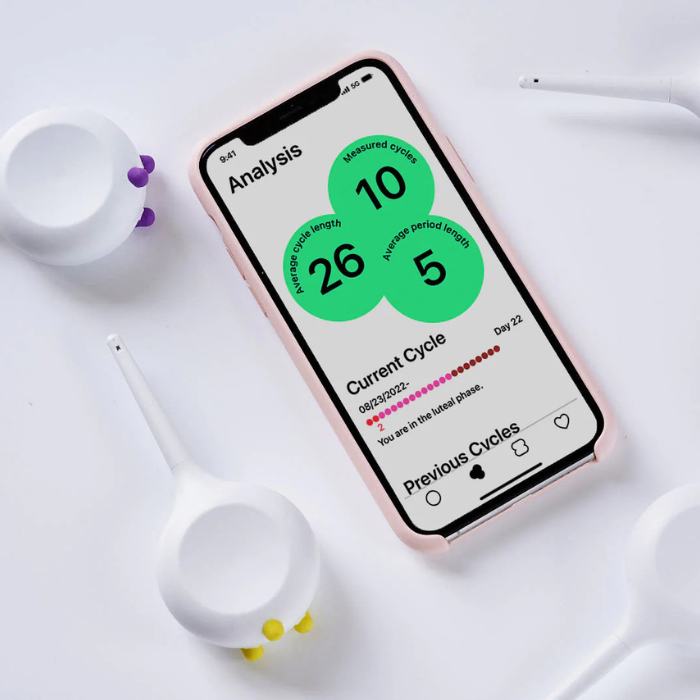
Most women today use an app on their phone to track their cycles, but are they able to ascertain the information necessary to understand how their bodies are functioning? A tracking app reflects data based on what is entered. If we are not able to provide the app with accurate observations, then the information it provides to us will be flawed. Most often, we only enter when our period starts and ends, but there is so much more our cycles encompass. Another consideration is that most tracking apps use algorithms based on a 28-day cycle to provide an estimation of ovulation. It is estimated that about 16% of women have a 28-day cycle and only about 13% ovulate on day 14, which is contrary to what has traditionally been taught. Where does that leave our Pregnancy Help clients?
Giving our clients the understanding and ability to learn the signs of her own fertility could be incredibly beneficial. Being attuned to identifying patterns is key to knowing what our body is communicating. Biomarkers are one such way that we can measure expected biological processes while also raising awareness when something might be amiss. Common fertility biomarkers include cervical mucus, basal body temperature, and hormone levels in urine and plasma. Of this list, cervical mucus is the most readily available to every woman.
What education can we provide our PHMC clients about their cycles?
During a cycle, a woman has a fertile window estimated to last about 6 days. Of course, this can vary from woman to woman and even cycle to cycle. Learning how to observe her biomarkers and what they mean can empower her to better identify her fertile period during her cycle. Whether her goal is to achieve or avoid pregnancy, this can prove useful over the entirety of her fertile years. According to an observational study published by the American Society for Reproductive Medicine, “when perceived accurately, more accurate clinical self-detection of the fertile window can be obtained by identification of peak mucus.” Does your client know the difference between fertile mucus and infertile mucus?
Fertile mucus is more estrogenic and conducive to providing an environment that supports sperm in reaching the egg upon ovulation. It is clear, lubricative in nature, and stretchy in consistency. The fertile mucus becomes increasingly copious towards ovulation. Infertile mucus is more progestogenic and creates a barrier for the cervix, making it unfavorable for sperm passage, and also provides protection from bacteria entering the cervix. It is opaque, dry, thick, and most often only observed in scant amounts. After ovulation has occurred, the corpus luteum produces progesterone, which helps support and protect a possible pregnancy. Progestogenic mucus may be observed during this time in the cycle. Progestogenic mucus may also be observed after menstruation due to the residual progesterone that was produced by the corpus luteum during the previous cycle.
Included below are the phases of a healthy cycle and basic events and observations of each:
- Menstrual phase- shedding of the uterine lining (bleeding)
- Follicular phase - signals follicle to prepare an egg (possible progestogenic mucus/ estrogenic mucus as ovulation approaches)
- Ovulatory phase- rapidly rising estrogen signals release of the egg (increasingly estrogenic mucus)
- Luteal phase- after ovulation; corpus luteum produces progesterone (progestogenic mucus)
What other factors could reveal more important information about her cycle health?
Other important factors to consider are symptoms that she notices throughout her cycle and any lifestyle factors that could affect her cycle. Symptoms are observations that signal what is happening in the body. Being aware of any symptoms such as acne, bloating, breast tenderness, fatigue, insomnia, irritability, pain, and weight changes (just to name a few) can help a woman better understand what her body is saying. Moreover, paying attention to when these occur during the cycle can be very revealing as well. When seeking professional help, these symptoms and the timing of their occurrence can help guide the medical professional as they care for a woman.
Lifestyle factors can also impact a woman’s cycle. Stress, diet, exercise, alcohol/tobacco/drug use, and medications or supplements taken can have an effect on a woman’s cycle. Noting these during her cycle, along with her other observations, can provide a more complete picture.
Hormones are responsible for many bodily processes. Working with your client to create healthy lifestyle goals can be beneficial for not only reproductive reasons but also for her overall health.
How can we practically apply education about fertility awareness?
Given all that has been shared in these three articles, here are three steps towards creating an action plan to apply fertility awareness education in your PHMC.
- Identify - Identifying those interested in learning more is a great place to start. Many clients in our pregnancy help medical clinics are seeking services that aim to educate and empower them. Find those interested in learning more about their bodies and how they function.
- Share - Provide educational materials for your clients that are easy to understand and communicate clearly how to make complete cycle observations. Using educational materials and fertility awareness apps that are informative and interactive can keep her engaged.
- Evaluate - As you share, continually assess her understanding, responsiveness, and your delivery of the education. Seek out further support or information regarding fertility awareness, as needed. There are a plethora of resources available to you as you collaborate with your client to assist her in understanding her cycles and when it is important to seek a higher level of care.
Maternity Housing Coalition | Leadership & Practice Series
The Space Between: Finding the Right Attachment in Maternity Housing Work
by Valerie Harkins, Executive Director, Maternity Housing Coalition
There is a tension that lives inside every good maternity home worker. It’s quiet most of the time, but it surfaces in the small moments. When a resident makes a choice you saw coming, you have to decide whether to step in or step back. When a young woman is circling the same painful pattern for the third time, and something in you wants desperately to grab the wheel. When a program rule feels cold in the face of a warm human story sitting right in front of you.
That tension doesn’t mean something is wrong with you. In fact, it might mean something is very right. The question is not whether you feel it; the question is how you manage it. Because that tension, held well, is precisely what makes great maternity housing work possible. Held poorly, in either direction, it becomes one of the most subtle and destructive forces in our field.
Let’s talk honestly about the two failure modes and the narrow, necessary road that runs between them.
The Problem of Over-Attachment
There is a kind of care that looks like love but functions like control. It’s warm, it’s well-intentioned, and it is quietly devastating to the people it intends to help.
Over-attached workers are not bad people. More often than not, they are the most passionate people on your team. They are the ones who stayed late, who cried in the car on the way home, who prayed hardest for the women in their care. But somewhere along the way, that passion crossed a line, and instead of walking with the resident through her journey, the worker began carrying the resident for her.
The clinical term for one dimension of this is toxic empathy, and it is worth understanding precisely. Healthy empathy is the capacity to feel alongside someone, to be genuinely moved by their pain, and to use that understanding to serve them better. Toxic empathy is what happens when that feeling becomes so consuming that the worker’s emotional state becomes entangled with the resident’s outcomes. At that point, the worker is no longer responding to the resident’s actual needs. She is responding to her own discomfort, her own need to see the resident succeed, to see the situation resolved, to relieve the ache of watching someone struggle.
The result is predictable: workers who over-correct. Who softens every hard edge. Who negotiate around natural consequences. Who quietly rearrange the environment so the resident never quite has to face the full weight of her own decisions.
And here is what that actually communicates to the resident, even when no words are spoken: I don’t believe you can handle this. I don’t trust you to grow from it. I need to protect you from yourself.
That message, however lovingly delivered, is profoundly disrespectful.
Consider this from a theological perspective. Christ did not remove free will to protect us from ourselves. He could have. Omnipotence affords that option. But He didn’t, because a life insulated from the consequences of one’s own choices is not a human life in any dignified sense. Free will is not a design flaw to be managed. It is the very mechanism through which transformation occurs. The prodigal son’s father did not chase him to the far country. He did not wire him money when the famine came. He let that young man sit in the mud with the pigs until something broke open inside him, and then he ran toward him. The father’s restraint was not indifference. It was the most profound form of respect he could offer.
When we over-shelter a resident from the consequences of her own choices, we are not being more loving than the Father. We are being less wise. We are removing the very friction that produces growth. We are, with all good intentions, robbing her of the lesson she came here to learn.
There is also a burnout dimension to this that we cannot afford to ignore. Workers who carry the weight of residents’ outcomes as if those outcomes belong to them will not last in this work. Compassion fatigue and secondary traumatic stress are well-documented in residential care settings, and over-attachment is one of their primary drivers. The worker who believes it is her job to save every woman who walks through the door will eventually be undone by the ones she couldn’t. Or worse, she will begin unconsciously choosing residents she believes are “save-able” and disengaging from those who are not. Neither outcome serves the mission.
The Problem of Over-Detachment
The opposite error is less emotionally dramatic but no less damaging. It wears a professional face. It follows every protocol. It produces clean paperwork and respects program boundaries. And it is hollow at its core.
Over-detached workers have learned, through exhaustion, through disappointment, through self-preservation, to create emotional distance between themselves and the residents they serve. They do their job. They complete the required check-ins, facilitate the required groups, and issue the required warnings. But somewhere in that process, the person sitting across from them has been replaced by a case.
This is the migration from serving the mission to serving the program. And it is more common than most of us want to admit.
A program, meaning its policies, schedules, rules, and procedures, is a tool. It is the scaffolding you build to create consistency and safety in a complex environment. A well-designed program is genuinely valuable. But scaffolding is not the building. It is not the reason you built the building. When workers begin treating the program as the point and the resident as the means of executing the program, something has gone spiritually wrong in the organization.
Here is the drift as it typically unfolds. An organization is founded on a burning sense of purpose. Someone saw a need, felt called, and built something to address it. In the early days, the mission is alive in the walls. Every decision, every exception, every conversation is filtered through the question: What does this woman need? As the organization grows, structure becomes necessary. Policies are written. Staff are hired. Job descriptions are formalized. This is not wrong; it is wise stewardship. But without intentional, ongoing cultivation of organizational culture, the structure slowly becomes the thing itself. Staff are evaluated on compliance with the program. Meetings are about program performance metrics. New staff are trained on the rules before they are formed in vision. The organization, imperceptibly and without anyone intending it, has begun to exist for itself.
C.S. Lewis described this kind of institutional decay as the corruption of something good rather than the creation of something evil. No one decided to stop caring about the mission. The mission simply got buried under the weight of operations.
And when the mission is buried, the residents feel it. They receive services, but they don’t receive presence. They are processed through a system, not welcomed into a community. They follow the rules because the rules are enforced, not because they are growing. And the moment they leave the program, the growth stops, because the growth was never really theirs to begin with. It belonged to the program.
We must remember: the soul of every resident who arrives at your door was directed there by God, not by your marketing budget or your referral network. That soul has a story and a dignity that no intake form can capture. To serve the mission of your organization is, ultimately, to steward the sacred trust of that person. When your organization begins to exist primarily for the purpose of being an organization, for sustaining its own programs, protecting its own budget, and perpetuating its own existence, it has ceased to be a ministry and become a bureaucracy. And bureaucracies, however well-funded and well-staffed, cannot do what you were built to do.
Engaged Presence Without Enmeshment
So what does it look like to get this right?
The goal is what some in the therapeutic community call engaged detachment, a posture that is fully present, genuinely invested, and emotionally alive, while remaining clear-eyed enough to stay out of the way when staying out of the way is the most caring thing you can do. It is not a halfway measure between caring and not caring. It is a third thing entirely, a more mature and more disciplined form of love.
Think of it as the difference between a guide and a rescuer. A rescuer is reactive. She cannot tolerate watching someone struggle, and her emotional system is organized around eliminating the struggle. A guide is intentional. She has been down the road before. She knows which falls are instructive and which are dangerous. She walks alongside, she points ahead, she celebrates hard-won progress, and she knows when to let someone sit with a difficult mile rather than carrying them through it. The guide is no less invested than the rescuer. She may actually love the traveler more, because her love is disciplined enough to serve the traveler’s actual growth rather than her own need for resolution.
In practical terms, this posture has several characteristics worth naming.
It makes room for failure. Maternity homes should be safe places to fail. Safety lives in the relationship and the environment, not in the absence of consequences. When a resident makes a poor financial decision, she should feel it. When she misses an appointment, that consequence should land on her, not be quietly absorbed by a well-meaning staff member. Remove the friction, and you remove the classroom.
It distinguishes between empathy and compassion. Empathy feels with someone. Compassion acts on their behalf, even when acting on their behalf means stepping back. A worker high in compassion can sit with a resident's pain without needing to fix it. She can say, this is hard, and I believe you have what it takes to get through it, and mean both parts equally.
It keeps the mission verbal and visible. The mission cannot be a sentence on the wall. It has to be the living reference point for every decision, present in staff meetings, in supervision, in the stories you tell about residents who have grown. Ask yourself: in your last three staff meetings, how much time was spent on program logistics versus talking about the actual people in your care?
It builds a program that bends without breaking. A healthy program is not static. The model that served your residents five years ago may not fit the women arriving today. Leaders attached to the mission rather than the program welcome that evolution. They expect it. A thoughtful adjustment each year is far healthier than clinging to a design because change feels risky or because the original model has become someone's professional identity.
It sustains the worker. Workers who care deeply but don't carry what isn't theirs to carry remain in this work. They don't burn out in two years. They don't grow the cynical shell that self-protection produces. They bring freshness to each resident because they were not depleted by the one before her. Understanding this balance is not a luxury for your team. It is a retention strategy and a quality-of-care strategy in one.
A Word to Leaders
If you are an executive director or program director reading this, I want to say something directly to you.
The culture of attachment in your organization is set by you. Not by your policies, by your example. The way you talk about residents in staff meetings, the way you respond when a resident fails, the way you frame success and loss for your team, all of it communicates what appropriate investment looks like. If you process residents as cases, your team will too. If you speak of them as souls, your team will too.
And when your program needs to change, when the data or the discernment or the direct feedback from residents tells you that something isn't working, be willing to name it and move. The most dangerous thing you can say in a mission-driven organization is: "This is how we've always done it." Because always doing it the same way is a declaration that the program matters more than the people. And you know better than that. That's why you're in this work.
A Closing Thought
We are a field full of people who chose this work on purpose. Nobody stumbles into maternity housing by accident. You are here because something called you here, a conviction, a story, a faith, a fire. That calling is real. Honor it by protecting it.
The women who come to your doors are not yours to save. They are God's to redeem. You are a part of that process, a vital, meaningful, irreplaceable part. But you are not the whole of it. Your role is to be present enough to love them well, and grounded enough in the mission that your love serves their growth rather than your comfort.
That is the narrow road. It is not easy to walk. But it is the one that leads somewhere.
Women's History Month 2026

Honoring women who are leading the way in pregnancy help around the world. Celebrating the compassionate leaders, faithful advocates, and courageous pioneers who are serving women and families every day—one organization, one community, and one life at a time worldwide
Purim: A Call To Prayer
by Michele Cheresnick, LAS, Affiliation Services Coordinator
Purim, the celebration of deliverance in the Book of Esther, has just passed. It reminds us that God works even when He seems hidden. It's a time to remember how God saved His people from destruction in Persia. A story of dramatic reversal: a death decree overturned, mourning turned into joy, fear replaced with feasting.
But before the celebration, there was prayer.
When Esther learned of the threat against her people, she called for fasting. Before she approached the king, she sought God. Though His name is never mentioned in the book, His presence is unmistakable. The victory began in a hidden surrender.
Purim reminds us that deliverance is often born in prayer.
As Christians, we see the greater fulfillment in Jesus Christ. Before the cross, Jesus prayed. Before resurrection joy, there was surrender in the garden. Our greatest reversal — from sin to salvation — flowed through prayerful obedience.
Now that Purim has passed, the invitation remains:
- Pray in crisis.
- Pray in calm.
- Pray when God seems silent.
The God who reversed the decree still hears. And He still moves when His people pray.
Juggling Glass and Rubber
by Andrea Trudden, Vice President of Communications and Marketing
Those who serve in pregnancy help rarely have quiet days. Phones ring. Clients arrive. Volunteers need direction. Donors need updates. Reports wait to be written. Somewhere in the middle of all of it, you are also a spouse, a parent, a friend, a church member, a ministry leader, and a person with a body and soul that require care. If you’re honest, you may even feel like you’re running a small logistics operation: family schedules, work deadlines, church commitments, kids’ activities, aging parents, community needs, and yes, self-care. It can feel like living in a constant juggling act.
There is a leadership metaphor that has endured for decades because it rings true. It’s often attributed to Brian Dyson, a former CEO of Coca-Cola, who is frequently credited with popularizing the “rubber balls and glass balls” illustration in a 1991 commencement address. The image is simple: you are always juggling. Some balls are rubber. If you drop them, they bounce. Others are glass. If you drop them, they crack, chip, or shatter. The lesson is not that you should juggle better. The lesson is that you should juggle wiser.
I first heard this metaphor in a deeply personal way last July. A friend on our prayer team at Pregnancy Help Institute told me she felt prompted to come over and shared this very image. She spoke about rubber balls and glass balls and gently reminded me to be careful about which ones I was trying so hard to keep in the air. That moment has stayed with me ever since. (Thank you, Jenny!)
Those working in pregnancy help, especially, are vulnerable to believing every ball is glass. The mission is urgent. The needs are immediate. The stories are heavy. When women face pressure, fear, or coercion, you can feel the weight of their situation after hours. That urgency can quietly convince you that you cannot let anything fall, ever.
But God does not ask you to be everywhere at once. He asks you to be faithful with what He has entrusted to you today.
Scripture gently reorders our priorities. In Luke 10:41–42, Jesus speaks to Martha, overwhelmed with serving: “Martha, Martha, you are anxious and troubled about many things, but one thing is necessary.”
Martha wasn’t doing a bad thing. She was doing many good things, all at the same time, and her soul was fraying. Jesus was not condemning service. He was calling her back to what mattered most.
That matters for us because pregnancy help is, by nature, a “many good things” calling.
Work may be one ball, but it’s connected to others. Family is not a sidebar to your ministry. Church is not an optional add-on. Activities and commitments, even good ones, can multiply until your calendar becomes your master. And self-care, though sometimes dismissed as indulgent, is often the simple stewardship of the body and mind God gave you.
So, how do we tell the difference between rubber and glass?
Start by naming your current “juggle.” For many in pregnancy help, it looks like this:
- Work: clients, staff care, volunteer training, fundraising, compliance, crisis response
- Family: spouse, children, household needs, elderly relatives, family rhythms
- Church: worship, small group, serving roles, spiritual leadership at home
- Activities: school events, sports, community responsibilities, friendships
- Self-care: sleep, nutrition, movement, counseling, quiet, sabbath, medical care
Now ask: which of these are glass for you right now?
Often, the “glass balls” include your relationship with God, your marriage, your children, your integrity, your health, and the trust of your team. When those crack, they take far longer to restore. Many leaders discover too late that neglecting sleep, skipping time with God, or living on adrenaline does not simply “bounce back.” It eventually incurs a cost.
Rubber balls are usually the things that can pause and recover without permanent harm: a less-than-perfect inbox, a delayed non-urgent project, a meeting that can be rescheduled, a volunteer task that can wait, a social commitment you can decline, a homemade dinner that becomes sandwiches. Rubber isn’t unimportant. It just means it can hit the ground and still return.
Here’s the permission many of us need: it is okay to let the rubber balls bounce.
That may mean choosing to leave work on time two nights a week so your family consistently gets you. Or saying “not this season” to an additional church responsibility, even if it’s a good one, because your first ministry is faithfulness where you already are. It could be stepping back from a child’s extra activity when your home needs you more. Or simply turning off your phone for a set hour, not because you don’t care, but because you do. And (the hardest at times) embracing self-care as stewardship: taking a walk, getting to bed, having a date night, seeing a doctor, practicing a true sabbath.
This is not selfishness. It is wisdom.
And here is the second truth: you can do it alone, but you don’t have to.
Pregnancy help work was never designed to be carried by one person’s strength. Galatians 6:2 calls us to “bear one another’s burdens, and so fulfill the law of Christ.”
That is not only for the women you serve; it is for you and your team.
Moses learned this the hard way. When the weight of leadership was too heavy, Jethro urged him to share the load, appointing others to help carry responsibility (Exodus 18). Even Jesus sent His disciples out two by two.
So ask for help without apology. Delegate. Train. Invite others to carry real responsibility, not just busywork. Let someone else answer the phone for an hour while you regain your bearings. Bring a trusted friend into your burdens in prayer. If you are in leadership, model healthy limits so your team knows they are allowed to be human, too.
The women and families you serve do not need you to be limitless. They need you to be faithful, steady, and whole.
You will keep juggling. That is life. But today, you can choose to juggle with discernment: let the rubber balls bounce, protect the glass ones, and remember you were never meant to carry this calling alone. God’s grace is not only for your clients. It is for you, too.
Nourish Your Soul: The Power of Rest and Learning
by Kathy Jerman, Director of Affiliate Services
In the pregnancy help movement, the needs never stop.
The phones keep ringing. The clients keep coming. The emails keep piling up. And for many of us, the weight of leadership, limited resources, and the spiritual intensity of this work can quietly drain our reserves. We pour out every day. But even those who are called must be filled.
As we approach our Annual Conference in Cincinnati at the end of the month, I want to gently encourage you to view this gathering not simply as professional development, but as soul care.
Rest Is Not a Luxury - It’s a Necessity
In pregnancy help ministry, stepping away can feel indulgent or even irresponsible. There is always more to do. But the truth is, you cannot sustainably lead from depletion. Time away is stewardship of your calling.
When you take a few days to step out of the daily demands of your center, you give yourself space to breathe deeply, listen more clearly to the Lord, reanchor your heart in God’s calling, and be reminded that you are not alone.
Nourishing Your Spirit
One of the most beautiful aspects of our time together in Cincinnati will be the intentional opportunities to encounter the Lord. Conference is not just workshops and strategy sessions. It includes:
- Dedicated worship time where we can collectively lay our burdens at His feet
- The opportunity for personal prayer with someone who will intercede specifically for you
- Morning Mass
- Quiet moments in between sessions, where the Spirit often speaks most clearly
Investing in Yourself as a Leader
Professional development is not self-promotion. It is wise leadership. Strong organizations are led by growing leaders.
Our workshops and keynote sessions are designed to sharpen your skills, expand your thinking, and strengthen your effectiveness. Whether it’s leadership development, board governance, client care, fundraising strategy, or medical advancements, you will walk away with practical tools you can implement immediately.
But beyond information, conference offers something even more powerful: perspective. When you gather with hundreds of leaders who understand the unique challenges of pregnancy help ministry, you discover you are part of something bigger: a united movement that is stronger together than any one center could ever be alone.
If You Aren’t Attending Conference
If you’re unable to join us in person or virtually, you can still nourish your soul intentionally. Nourishment is not location-dependent. It is intention-dependent. Here are intentional ways you can still rest, grow, and refill.
- Schedule a personal mini retreat to reflect and pray. Block it on your calendar. Protect that time. Go somewhere quiet, like a park or a coffee shop, with your journal. Leave your laptop closed. Silence notifications.
- Ask a trusted friend, pastor, or colleague to pray over you specifically as you serve in your center. We spend so much time interceding for others. Being prayed for is humbling and healing.
- Create your own learning track. Professional growth doesn’t only happen at events. Choose one area this month where you want to grow. Then commit to reading a book on the topic, listening to a podcast or a webinar, or ask someone to mentor you.
- Reconnect with worship. Attend a weekday service. Begin your next team meeting with an extended time of prayer. Protect one true day of rest each week.
- Build a community around you. Schedule a virtual meeting with another director. Start a monthly prayer call with nearby centers. Text someone in the movement and ask how they’re really doing. Pray with them and encourage them. We are better together!
Come Be Filled
If you are joining us in Cincinnati, come expectant.
Expect the Lord to meet you.
Expect meaningful conversations.
Expect renewed vision.
Expect laughter.
Expect rest for your weary soul.
If you’re not joining us, be just as intentional at home. Block the time. Ask for prayer. Learn something new. Worship deeply. Rest boldly.
Return Ready to Jump Back In
Whether in a conference convention center or in your own quiet space, the goal is the same: to return refreshed and ready to jump back in with fresh energy, deeper faith, and renewed passion for the sacred work we’ve been called to do.
You deserve time to rest and learn. More importantly, the sacred mission you lead deserves a spiritually grounded, continually growing leader.
Let’s commit to nourishing our souls so we can continue serving with courage, compassion, and conviction.
The Power of Love in Wild, Wild 21st Century
by Joe Malone, PhD, SRAS, CPT, LWMC, CFE
Most of us would probably agree that the 21st century has brought a great deal of crazy sexual anarchy to Western countries, including the UK and the USA. This has been magnified by the bombardment of oftentimes harmful and sometimes blatantly pornographic visual and verbal influences on our 21st century young people. Movements that have found traction in this time include InCels (involuntarily celibate men), DINKS (double income no kids couples), and the 4B (The 4 No’s) Movement, a radical feminist group that began in South Korea. This group of young women believes the following:
No Dating
No Sex
No Marriage
No Children
We will focus on the 4B Movement and contrast what science, Scripture, and the Power of Love say about adopting this lifestyle.
No Dating: The originators of the 4B Movement direct young women to not date men. Dating is the relational step that opens the door to romance, which they see as harmful. How do science, scripture, and the Power of Love see it? Science shows that the vast majority of women are designed for romantic love. Before birth, in utero, a female’s brain is shaped and configured by hormone exposure to be sensitive to the effects of oxytocin once they later go through puberty. For this reason, as both sexes go through puberty, the girls end up with three times the bonding drive that boys have at 16, and boys end up with three times the sex drive. In our past cultures of sexual integrity, this drove males toward romantic dating of females, and sex was cherished within the blessings of marriage. With the sexual devolution trying to destroy romantic love, girls who were less likely to be depressed at the beginning of puberty are more than twice as depressed as boys by age sixteen. Unfortunately, this condition lasts for the next 30 years.
What does Scripture and the Power of Love say? In the creation process in Genesis, the first thing that God realized was that it wasn’t good that man was alone. Dating (or more accurately, Christian Courtship, which we at ROMANCE REVOLT prescribe) is the first step to man not being alone for the rest of his life.
No Sex: Here we have a partial agreement with the 4B adherents. We agree that promiscuous sex, as in modern hook-up culture, is a travesty and goes against, particularly, most women’s sexual nature. We believe strongly, though, that sex within marriage is one of God’s greatest blessings to us as humans. Sex needs to be kept within its proper place, and when it is, science shows that it helps young men to bond, or as we call it, fall in love. Vasopressin, which is the main male bonding biochemical, requires a chaste courtship for an extended period of time to work. Extramarital sex destroys the vasopressin buildup in a young man’s brain, and he never falls in love. While under the same circumstances, because of different brain biochemistry, young women do fall in love. This results in many female heartaches and heartbreaks across Western society!
What does Scripture and the Power of Love say? God said to Eve, your desire will be for your husband. This is what makes humans a monandrous (in the Greek mon=one, andro=man woman) species. This is the cause of human women having the anatomy and biochemistry that empower them to practice sexual integrity better on average than men.
No Marriage: This may be one of the 4B’s biggest miscalculations. Science shows that if young people want to live a long, happy, and healthy life, marriage is one of the most effective ways to achieve that. Being married adds an average of two years of life expectancy for women and a whopping 10 years for men! Marriage quality is the number one predictor of life happiness. Finally, being married reduces your chance of everything from hospitalization and need for surgery, to clinical depression and heart attack, just to name a few.
What does Scripture and the Power of Love say? That is why a man leaves his father and mother and is united to his wife, and they become one flesh. A happily married couple’s blood pressure drops, and their heartbeats synchronize when they lie down to sleep together at night. This is not true for an unhappily married couple or a cohabiting couple.
No Children: the 4B must not realize it, but getting married and starting to have children younger, therefore being able to have more of them, and breastfeeding each one of them for one year greatly benefits young women’s future health and sexual wellness greatly. For example, science shows that a woman who has her first baby closer to age 20 has half the chance of breast cancer than one who has her first at around 30. The same two-to-one positive ratio is true for a woman who has five or more children compared to those who have none. Breastfeeding, especially on demand for a year or more, also has a large future anti-cancer effect. These are better for the health of the children, too, because as a woman ages, her eggs that she has had since she was in her mother’s womb age as well and are prone to produce chromosomal abnormalities.
What does Scripture and the Power of Love say? Behold, children are a heritage from the Lord, the fruit of the womb a reward.
To conclude: GOD IS LOVE, and we are to follow His ways and therefore practice His ultimate wisdom in our relationships!
Limited Obstetrical Ultrasound Exam: The Required Images
by Tammy Sterns, MS, RDMS, RVT, RT(R), FSDMS, FAIUM, LAS
The Limited Obstetrical Ultrasound Exam performed in Pregnancy Help Medical Clinics (PHMCs) answers specific questions to provide the mother with the information that she needs to make an informed decision regarding her pregnancy. The exam itself is limited in nature due to the narrowed purpose of the exam. Typically, the mother is needing to know the gestational age of the pregnancy along with the approximate due date. By virtue of the integrity of the scan, the imager also seeks to confirm that the pregnancy is, at that moment, alive and is located within the endometrial cavity within the uterus. The imager is also able to visualize the baby so that the mother can actually see the life inside of her and realize the reality of the pregnancy to begin the mother-fetal bonding process. This is what is unique regarding imaging in PHMCs.
Our focus is life-affirming for both the mother and her baby. If the mother chooses to continue the pregnancy, a more detailed, complete ultrasound exam is performed to assess the pregnancy and baby once she begins prenatal care.

The limited scan images the vagina, cervix, uterus, and adnexa in both longitudinal and transverse, scanning the entirety of the structures to provide visualization and thorough evaluation of the pelvic area. It is recommended to perform a systematic scan to ensure that the exam images all the structures. Starting longitudinal at the pubic symphysis, the vagina, cervix, and uterus are imaged midline. The scan continues angling towards the mother’s right side through the uterus and the entirety of the right adnexa. Returning back to midline, the imager angles left through the uterus and the entirety of the left adnexa. Turning the transducer transverse (notch to the mother’s right), the imager, remaining in the sonographic window of the full bladder located at the level of the public symphysis, angles superiorly, noting the level of the vagina, cervix, lower uterine segment, transverse uterus, fundus of the uterus, and angling superior past the uterus. Transverse imaging of the right and left adnexa, scanning from inferior to superior, is also performed. During this time, the imager is evaluating each structure in regard to its appearance, size, and shape.
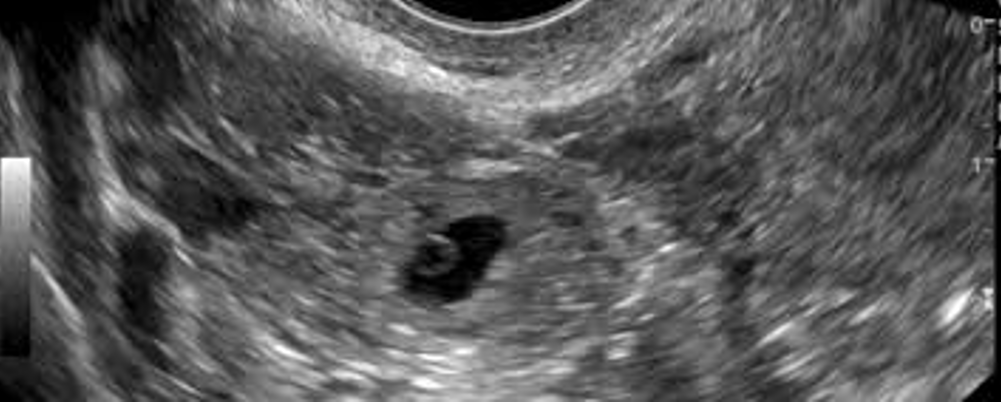
Once the baby is located and the fetal heartbeat is confirmed, the direction of the scan turns to allow the mother to witness the life growing inside of her. As imagers, we are on Holy Ground as we are literally watching the baby being knitted in its mother’s womb right before our eyes. Let us take time to revel in the wonder with her as we are able to show her the baby’s features, including the beating heart. This is the most important time of the scan as the mother is able to see her baby for the first time. The baby’s feet and hands, along with the profile, are impactful images for her and her support system to see. These are perhaps the required images in imaging life.
After the mother has seen her baby and the baby’s features have been shown, it is important to document the required information regarding the exam.
If apregnancy is visualized, the following images should be documented. A transvaginal exam may be performed if information is not obtainable transabdominally.
- A longitudinal or transverse image documenting the location of the gestational sac within the endometrial cavity within the uterus.
- An m-mode image documenting the baby’s heart rate.
- A gestational measurement. (Mean Sac Diameter, Crown-Rump Length or Femur Length)
- A copy of the worksheet or report from the machine with the EDD and Gestational Age.
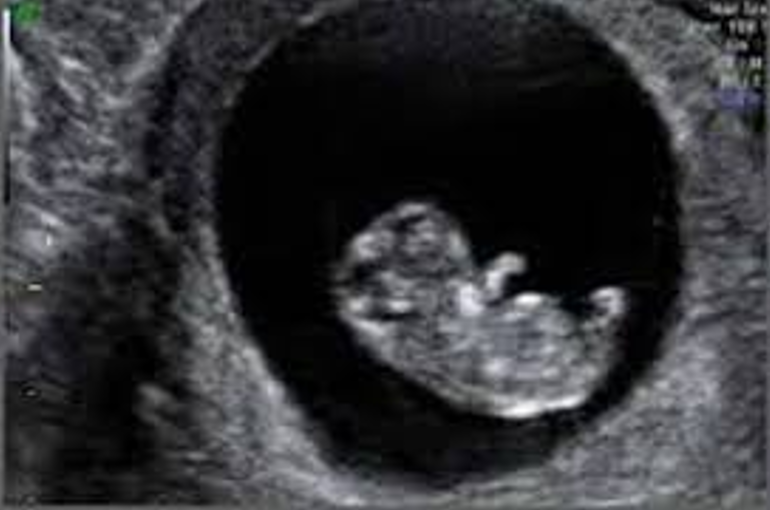
If, while completing the systematic survey, an area of concern is visualized, documentation of that area should also be included as directed by each specific PHMC Policy and Procedure per the Medical Director.
If an ectopic pregnancy is visualized, the following images should be documented.
- A longitudinal or transverse image documenting an empty endometrium and (if present) a pseudosac.
- A longitudinal or transverse image documenting the location of the ectopic pregnancy.
- Yolk sac (if present)
- An m-mode image documenting the baby’s heart rate. (if present)
- A gestational measurement, if available, or image of an adnexal mass. (Mean Sac Diameter or Crown-Rump Length)
- A longitudinal or transverse image documenting any presence of free fluid.
- A copy of the worksheet or report from the machine with the Gestational Age.
Policies and procedures should indicate the images required for the Limited Obstetrical Ultrasound Exam. They may vary greatly from each PHMC's Medical Director based on their personal preference. For some PHMCs, the preference may be dependent on the type of permanent image created.
As an imager, it is to be noted that whether the image is documented as a permanent image or not does lessen the responsibility of the imager to duly image systematically for each scan. The beauty of ultrasound is its dynamic ability to image life by creating literal images as the transducer is being angled, leaving the responsibility of imaging thoroughly with the imager. Therefore, each image created is to be evaluated.
Imaging Life is such a gift, a privilege, and a responsibility. However, it is imperative that we remember the purpose behind the exams within pregnancy help. The purpose, the why, is to give her the information she needs at that moment in time to make the decision she needs to make. That information is extremely limited when compared to the complete and more in-depth ultrasound studies that the baby will receive during prenatal care if its mother chooses life.
Let us not get too caught up in the technicalities of trying to perform a complete study that hasn’t been ordered, while sacrificing precious time that could be spent imaging the baby for the mother to see.
It truly is so much more than just a scan.
Why the Policies You Want Aren't the Ones You Need
by Valerie Harkins, Executive Director of the Maternity Housing Coalition
There is a very human impulse that shows up again and again in maternity housing leadership:
“Can I see your policies and procedures?”
“Does anyone have a full set I can use?”
“We just need something to get us started.”
This desire is understandable. Housing ministry is weighty work. Leaders are carrying legal responsibility, pastoral responsibility, donor trust, staff wellbeing, and the lives of mothers and children—all at once. Wanting a pre-written roadmap is not laziness; it’s fatigue mixed with responsibility.
But here’s the quiet truth we rarely say out loud: what feels like a shortcut at the beginning often becomes a long detour for years to come.
Why Housing Is Different
In many ministries, templated policies can be a reasonable starting point. Pregnancy centers, for example, often share core operational similarities: appointment-based services, limited client duration, standardized service models.
Housing is different.
Housing is incarnational. I’ve been pondering this word lately. The housing ministry is embodied, relational, and constant. You are not serving a client for an hour—you are stewarding a home, a community, and a shared daily life. The mission is lived out at 2:00 a.m., at the dinner table, in conflict, in relapse, in reconciliation.
Because of that, policies and procedures are not neutral documents. They are theological, sociological, and practical statements about what you believe human dignity requires in your context.
A policy that makes sense for:
- A home serving college students
- A home serving women exiting street homelessness
- A home serving women from a reservation community
- A home serving women in addiction recovery
may share vocabulary—but they should not share substance.
If they do, something important has been skipped.
The Temptation to “Model After” Another Program
It’s tempting to build a program by modeling it after a respected home:
“They’re established.”
“They’re doing it well.”
“We’ll adjust later.”
But program design doesn’t begin with policies. It begins with discernment. When that step is bypassed, policies quietly become misaligned with mission—and the misalignment doesn’t stay contained. It seeps into staff culture, resident expectations, board confusion, and eventually, outcomes.
Policies written before clarity do not save time. They simply postpone the work until it is harder to undo.
What Policies Are Actually Meant to Do
Healthy policies are not aspirational documents. They are protective agreements that flow from three anchors:
- Your Mission
Not a generic mission. Your mission—clearly articulated, bounded, and honest about what you are and are not called to do. - Your Community Needs Assessment
Who are you serving in reality, not on paper? What histories, risks, strengths, and patterns show up consistently in your home? - Your Indicators of Success
Three to five measurable outcomes that, if achieved, mean your mission is being fulfilled at a baseline level.
Only after those anchors are in place do policies make sense. And once policies are clear, procedures naturally follow. Procedures exist to serve policies—not the other way around.
On Measuring Outcomes (Yes, You Can)
Many leaders quietly resist outcome measurement—not because they don’t value excellence, but because goals feel ambiguous or overwhelming. That hesitation is usually a signal, not a failure.
It typically means one of two things:
- The mission statement needs refinement, or
- The organization needs support in learning how to measure what already matters.
There are very few—if any—outcomes in the housing ministry that cannot be measured in some meaningful way. Measurement is not about control; it’s about unity and integrity. It aligns boards and staff, honors constituents, strengthens donor trust, and—perhaps most importantly—guards against mission drift.
What you do not define, something else will define for you.
Learning From One Another—The Right Way
None of this means we stop learning from one another. On the contrary, learning is essential. But how we learn matters.
The strongest growth happens through:
- conversation, not document dumps
- context, not copy-paste
- relationships, not repositories
Networking allows leaders to explain why a policy exists, who it serves, and where it struggles. It allows differences to be respected rather than erased. It strengthens the field without flattening it.
When policies are shared relationally—through story, dialogue, and discernment—everyone grows wiser without compromising their own mission.
A Gentle Invitation Forward
If you feel the pull toward ready-made policies, pause—not to shame yourself, but to listen. That pull often signals a deeper need: clarity, confidence, or companionship in leadership.
Mission leads.
Data clarifies.
Outcomes focus.
Policies protect.
Procedures serve.
That order matters—today and ten years from now.
The companion handout, "Indicators of Success," will help you think through this process. And as always, you are not meant to do this work alone. The strength of this Coalition has never been uniformity—it has been faithfulness, thoughtfully lived out in very different homes, for very different women, with the same deep commitment to life and dignity.
