
Savonne Torain
Constructive Artifacts in Ultrasound
by Tammy Stearns, MS, RDMS, RVT, RT(R), FSDMS, FAIUM, LAS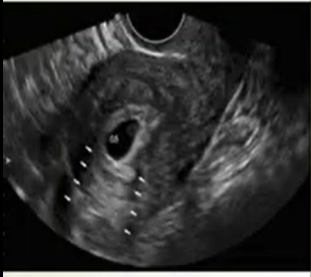
Often when one hears the term artifact, there is the reactionary thought of how to correct it, eliminate it and make it disappear. However, in ultrasound certain artifacts can be useful to the imager and contribute to the information gleaned from the exam. If utilized well, certain artifacts help to determine the composition of the structure, the technical features of the exam, and the direction in which the imager should follow while imaging.
Basic Properties of Sound
The physical properties of sound, how it traverses the body, and ultimately contribute to the composition of the image on the ultrasound screen, is daily utilized by imagers to help determine the structures being imaged. The basic parameters of imaging with sound include the transmission of waves by a transducer which react with the body’s tissues to create images based on acoustic impedance, reflection, scattering, and attenuation. The type of interaction that occurs is dependent on the stiffness and density of the structures that it encounters. As the sound beam travels through the body, it weakens in accordance with the composition of the structures in which it traverses. The portion of the beam that bounces back to the transducer is then converted into a level of white, black, or various shades of gray, dependent on the intensity of the received sound beam in comparison to the sound beam that was transmitted. Weaker signals are blacker while strong signals are brighter or white.
Helpful Artifacts
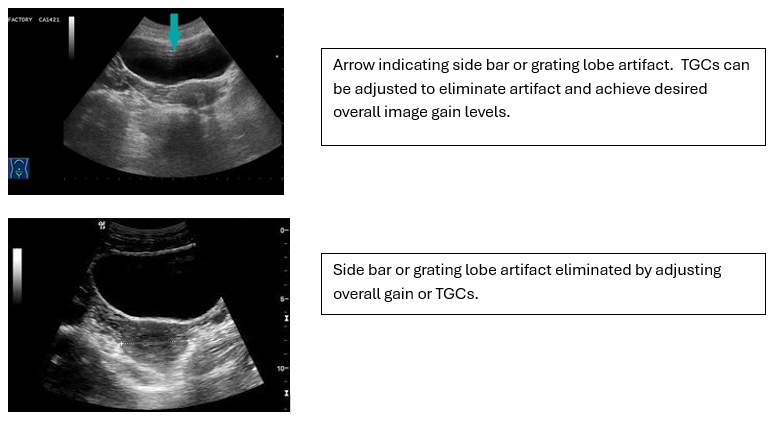
The Side Lobe or Grating artifact can often be found in the full bladder, which is necessary to scan a transabdominal pelvis. The interface of the bladder wall and the fluid within the bladder creates conditions that cause the sound beam to create what appears to be white or echogenic (white) lines across the anterior portion of the bladder. They are typically faint and can extend beyond the bladder wall. They are not consistent in their presence or appearance as the structure is imaged in two planes, nor do they remain as the bladder is emptied or when the patient changes positions, thus confirming they are artifact by nature. While they can be degrading to the overall appearance of the image, they provide a reference as to how to adjust the overall gain of the image. This can be accomplished by adjusting the overall gain or moving the TGCs inward. By knowing that they are simply artifacts, the imager can utilize them as a guide to darken the image by decreasing the gain until they are no longer visible.
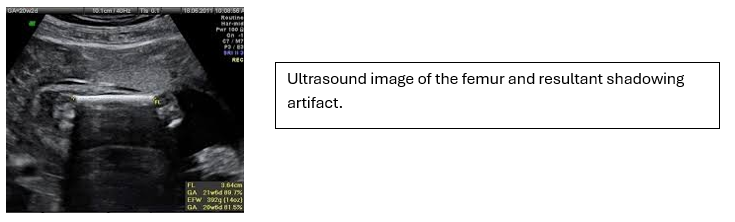
Shadowing occurs when an object has a significant attention coefficient that results in the sound beam hitting the object and instead of passing through the object, the sound beam bounces directly back. This results in the structure posterior to the object to not be imaged or displayed on the ultrasound screen due to lack of information gained. An example would be the femur length. The sound beam will travel to the femur, a hard bone with high levels of stiffness and density, hit the bone and bounce back to the transducer. Everything posterior to the femur is not imaged due to the sound beam not being able to pass by the femur itself. This provides the imager with the information that this structure has a significant level of stiffness and density confirming, most often, that it is either bone or a significant calcification. This is not an artifact that needs to be minimized or eliminated yet is utilized to help in the imaging process. If it is necessary to image the structures directly posterior to the structure that are obscured by the shadowing, scanning at a different angle or through a different sonographic window can be helpful.
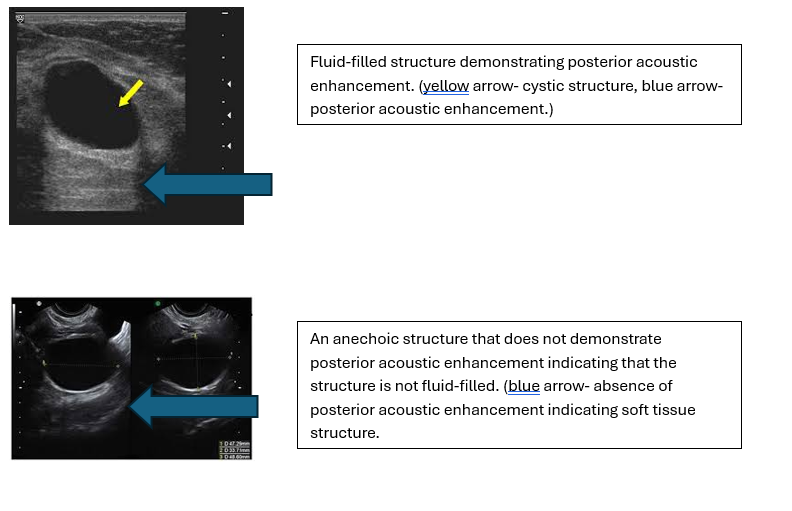
Posterior Acoustic Enhancement is an artifact that provides information regarding the cystic nature of the structure. As the sound beam travels through the body, it is attenuated at different levels dependent on the structure through which it is traveling. The attenuation rate is determined by the level of stiffness and density of the structure. Whereas shadowing is caused by the great level of attenuation of high level of stiffness and density in bone, a structure that is cystic allows the sound beam to travel through with less attenuation than the soft tissue that surrounds it which results in the area directly posterior to the structure to be brighter than the adjacent soft tissue. This allows the imager to differentiate between structures as being soft tissue masses or cystic (fluid-filled). Certain masses can appear to be cystic due to their hypoechoic or almost anechoic (black) appearance, however, without demonstrating posterior acoustic enhancement (brightness or white appearance directly posterior), it can be determined that they are not fluid-filled because of the attenuation that has traveled through the structure is the same as the adjacent soft tissue. However, a structure with the same appearance as a soft tissue mass can be determined to be cystic or have significant cystic components as it demonstrates posterior acoustic enhancement or brightness posterior to the structure.
By recognizing and utilizing the information obtained with artifacts that are helpful to the imager can determine whether structures are cystic, soft tissue, or bone. The artifacts can also help the imager determine the level of darkness necessary regarding the overall image appearance on the ultrasound screen. While there are artifacts that can lead to image degradation and need to be eliminated, the artifacts that offer key information are invaluable to the imaging process.
Patient Outcomes Influenced by Thoughts
by Brooke Myrick, BSN, RN, LAS
The power of the mind and the impact of the thoughts generated by the mind are more significant than most believe. As it is widely agreed that anxiety, worry, and stress are not optimal health choices, the extent to which these choices influence one’s health trajectory is receiving increased consideration.
In the Yale Journal of Biology and Medicine, the connection of healthcare professionals choosing to provide care and support with the incorporation of holistic strategies, including a positive mindset in patient outcomes, is carefully discussed by Angel D. Prabakar in The Power of Thought: The Role of Psychological Attentiveness and Emotional Support in Patient Trajectories.
Holistic care can be defined as seeking to treat the individual as a whole - encompassing physical, emotional, social, and spiritual health.
Incorporating holistic care into medical services can improve patient outcomes.
In the Pregnancy Help Medical Clinic (PHMC), the best and healthiest outcome for all women and families being served should always remain steadfast and at the forefront of each interaction and medical service provided by the clinic's medical professionals. The PHMC medical professional could be one of the first to express positive support filled with genuine love and care to the patient/client, instilling in them the confidence that a positive outcome is possible for their life.
Prabakar found in his case studies that when a patient is more involved in their healthcare, they will also be more motivated to comply with their plan of care. Additionally, when the patient incorporates positivity into their thoughts and mindset by remaining hopeful, these actions tend to correlate to a more positive result.
It is worth noting that Prabakar also makes mention of the impact of strong social support, coping mechanisms, and life experiences, findings cited in the National Library of Medicine that greatly influence a patient’s ability to maintain a positive mindset, which also increases the likelihood of healthier behaviors.
As we know, before any science or case studies, God’s word existed. He has been teaching and instructing us from the very beginning to trust Him. When we follow his commands, we receive a blessing. When we choose not to follow his commands, we are outside of his best for us and have varying consequences.
God provides instructions about thoughts and the mind in The Holy Scriptures because He created us and knows the impact our thoughts and minds have on our mind, body, and even our soul. There are many scriptures provided to us that specifically emphasize the power of the mind and the blessing of hope and rest when we choose to trust Him.
Finally, brothers, whatever is true, whatever is honorable, whatever is just, whatever is pure, whatever is lovely, whatever is commendable, if there is any excellence, if there is anything worthy of praise, think about these things. Philippians 4:8
…casting all your anxieties on him, because he cares for you. 1 Peter 5:6-7
May the God of hope fill you with all joy and peace in believing, so that by the power of the Holy Spirit you may abound in hope. Romans 15:13
Do not be conformed to this world,[a] but be transformed by the renewal of your mind, that by testing you may discern what is the will of God, what is good and acceptable and perfect. Romans 12:2
Set your minds on things that are above, not on things that are on earth. Colossians 3:2
...take every thought captive to obey Christ. 2 Corinthians 10:5
As we speak with our patients/clients in the Pregnancy Help Medical Clinic about their health circumstances and life choices, we can incorporate recent findings concerning the impact of a positive mindset while we also share God’s truths. After all, one of the greatest blessings of being a medical professional within the PHMC is the gift of being sent out to share the gospel of Jesus Christ and the hope that can only be found in Him.
I came that they may have life and have it abundantly. John 10:10b
For I delivered to you as of first importance what I also received: that Christ died for our sins in accordance with the Scriptures, that he was buried, that he was raised on the third day in accordance with the Scriptures. 1 Corinthians 15:3-4
As followers of Jesus Christ seeking to know Him, and being commissioned to make Him known as medical professionals within the PHMC, we should read, study, and memorize God’s words so that we can live them out and put them into action in deed and in truth, as we serve those seeking our help.
Little children, let us not love in word or talk but in deed and in truth. 1 John 3:18
But be doers of the word, and not hearers only, deceiving yourselves. James 1:22
Within the PHMC, we also have the opportunity and privilege of incorporating holistic medical care and support, for the whole woman, as we learn about her physical, emotional, social, and spiritual circumstances.
This holistic care and these biblical truths are provided when the L.O.V.E. Approach is included in the medical services. This biblical approach of listening and learning, discussing open options, sharing vision and value, and extending help and empowering her to follow through, provides care to the whole woman. This process includes the patient/client in their care, options, and vision, which in turn, could lead to increased follow through and compliance.
Medical care within the Pregnancy Help Medical Clinic is uniquely orchestrated in such a way that as she receives medical care, she is also receiving strong support, coping mechanisms rooted in Christ, and positive life experiences set apart from her encounters in the world.
Our prayer for you is Hebrews 10:23, Let us hold fast the confession of our hope without wavering, for he who promised is faithful.
The Medical Impact team appreciates all you are doing for life for His name’s sake. As you consider providing holistic care to the whole woman you are serving, we are here to support you, encourage you, help you, and pray for you. We would love to hear from you! You can reach our team at This email address is being protected from spambots. You need JavaScript enabled to view it.. May the Lord bless you and keep you!
When Good Teams Disagree: How to Navigate Hard Resident Situations with Wisdom and Integrity
by Valerie Harkins, Executive Director, Maternity Housing Coalition 
Why Disagreement Is Not a Sign of Failure
Any organization that does meaningful work long enough will eventually face an uncomfortable but unavoidable reality: thoughtful, committed people will sometimes disagree about what should be done.
In maternity housing, those disagreements often arise at precisely the moments that matter most. A resident’s behavior may raise concerns about safety, accountability, community standards, trauma, or fairness. One staff member may feel the situation requires a firm boundary. Another may believe the behavior reflects distress rather than defiance. A third may worry about what message the decision will send to other residents. None of those instincts is necessarily wrong. In fact, the presence of competing concerns is often evidence that people are taking both the resident and the mission seriously.
We should stop treating disagreement as a sign of dysfunction. Very often, it is a sign of health.
A team that never disagrees may not be united; it may simply be unexamined. In a healthy organization, people bring different experiences, convictions, and discernment to the table. That can create friction, but friction is not always a threat. Sometimes it is the very thing that keeps us from making shallow decisions. As the saying goes, when we pray for rain, we should expect mud. If we ask God to grow a ministry, deepen its impact, and entrust us with vulnerable lives, we should not be surprised when some of the work becomes difficult to navigate. Ministry is sacred, but it is rarely neat.
Start with the Mission, Not the Rulebook
So what should a team do when it cannot agree on how to respond to a resident’s behavior or circumstances?
The first step is to resist the instinct to run immediately to the rules. Begin with the mission, not the program handbook.
That distinction matters more than many leaders realize. Policies and procedures are essential, but they are not the heart of the organization. They are tools meant to serve the mission, not substitutes for it. In moments of conflict, teams can become overly procedural, reaching for policy language as though it alone can answer moral, relational, and organizational questions. But before asking, “What does the rule say?” a wiser question is, “Why do we exist?” What is the organization called to protect, cultivate, and offer? What are we fundamentally here to do? When a team reorients itself to mission, it is far more likely to make a decision marked by both clarity and integrity.
Separate Facts from Emotion
After that, the group must review the facts of the circumstance as plainly and soberly as possible. This requires discipline.
Difficult resident situations generate strong emotions, and understandably so. Staff members may feel disappointed, protective, frustrated, fearful, or heartsick. Those emotions are real, and they should not be mocked or dismissed. But they must not be allowed to dominate the process. Good discernment depends on the ability to separate what is known from what is assumed, what is documented from what is inferred, and what actually occurred from the emotional atmosphere surrounding it. The question is not how the situation feels in the room; the question is what is true.
For Faith-Based Organizations, Pause to Pray
For faith-based organizations, this is also the moment to pause and pray together.
Not performatively. Not as a spiritual courtesy before continuing with a decision already made in everyone’s mind. Pray because wisdom is needed. Pray because human judgment is limited. Pray because leadership, especially in complex and emotionally charged situations, requires more than policy knowledge and professional instinct.
Invite the Holy Spirit to guide the conversation. Ask for discernment, humility, restraint, and unity. Ask to see the resident clearly, and to see yourselves clearly as well. Prayer does not always remove complexity, but it often changes the quality of attention we bring to it. That alone can alter the course of a conversation.
Take an Honest Inventory of Resources
From there, the team must turn to the practical question of resources. Even when a compassionate or creative response seems possible, the organization must ask whether it can responsibly sustain it.
Do we have the time? Do we have the staffing capacity? Do we have the financial margin? Could this situation be managed well, even if doing so stretches beyond ordinary program norms? These are not cynical questions. They are necessary ones. It is not merciful to promise what an organization cannot faithfully carry. Mature compassion is not simply generous in spirit; it is honest about capacity.
Ask Whether the Response Still Aligns with the Mission
This is where many leadership teams make their most important distinction. The issue is not merely whether something can be done. The issue is whether it should be done in a way that remains aligned with the mission.
Some circumstances fall outside normal expectations yet still represent a meaningful and mission-consistent opportunity to serve. There are also circumstances in which continuing to intervene may no longer reflect wise stewardship of the organization’s calling, people, or resources. The aim is not to protect institutional comfort. Nor is it to stretch grace beyond the point of responsibility. The aim is faithful alignment.
When Consensus Cannot Be Reached
And then comes the final, often overlooked principle: if the group still cannot reach a unified and collegial consensus, the matter should be escalated to the director for a final decision.
That is not a breakdown in the process. It is part of the process.
Healthy organizations do not require unanimous instinct; they require clear leadership. A team may do all the right things—return to mission, clarify the facts, pray, assess resources, deliberate thoughtfully—and still remain divided. At that point, someone must be entrusted to make the final call. That is one of the burdens of leadership.
Support the Final Decision
But once that decision is made, the team has a responsibility to support it, provided it does not bring harm to the resident or to staff.
Internal disagreement should not become ongoing internal sabotage. A team can hold differing personal views and still choose institutional solidarity. In fact, that kind of maturity is one of the marks of a trustworthy ministry.
This is especially important in maternity housing, where staff are constantly asked to hold compassion and structure in the same pair of hands. That tension does not disappear with experience. If anything, the longer one serves, the more one understands how rarely difficult situations fit neatly into policy language. But that does not mean the work becomes arbitrary. It means the work requires wisdom. It requires moral seriousness. It requires the kind of leadership culture in which disagreement is neither feared nor indulged, but carefully stewarded.
A Final Word
The strongest teams are not the ones that avoid hard conversations. They are the ones that know how to have them without losing their center.
Disagreement, in itself, is not the enemy. The real danger is a team that forgets who it is, why it exists, and how it is meant to lead when the path is unclear. If we can remain anchored in mission, honest about facts, dependent on God, realistic about resources, and respectful of leadership authority, then even our most difficult internal disagreements can become occasions for deeper clarity and stronger unity.
And that, too, is part of faithful ministry.
Heartbeat's Governing Essentials Checklist
Could your Board, Executive Director and organization benefit from Heartbeat’s Governing Essentials Consultation? Let’s find out.
Check all that apply.
If you checked 2 or more of the above, it’s time for a Heartbeat International board consultation expert to come alongside you. Reach out to us today! This email address is being protected from spambots. You need JavaScript enabled to view it.
Spiritual Spring Devotional
by Lauri Campbell, LAS, Affiliate Coordinator
See, I am doing a new thing! Now it springs up; do you not perceive it? I am making a way in the wilderness and streams in the wasteland. Isaiah 43:19
In February’s devotional, we discussed Navigating a Spiritual Winter. April seems like a great time to consider how we might approach a Spiritual Season of Spring, especially since many of us are fresh from the Conference in Cincinnati or the virtual Conference. New ideas abound!
When God takes us through a Spiritual Spring, it is a time to plant and implement the instructions we received from Him during a Spiritual Winter. He’s doing a new thing that requires our attention and action.
Now is the time to use the fresh, renewed sight He has given us and plant some things that will bear good fruit in our lives and for His Kingdom. The insight and rest we received from the winter season provides spiritual enthusiasm for the hard work of planting.
Has God refined your mission? Calling? Vision? Assignment?
Has your faith been strengthened to accomplish what He’s called you to do?
Has He given you a brand new assignment?
Maybe He simply realigned your heart with your assignment and there’s a holy confidence you lacked before.
Whatever it is, it’s new and God is doing it in and through you. But planting is where the work begins in many ways. It can take the form of training and education to prepare for the harvest of new fruit. It may look like enlisting a mentor to sharpen you professionally or spiritually for the work that lies ahead. A Spiritual Spring can yield new connections that require cultivation in order to steward them well.
The Bible teaches that the work you do now will determine your fruit in the future, so plant wisely. “Whoever sows sparingly will also reap sparingly, and whoever sows generously will also reap generously." (2 Corinthians 9:6).
The Scripture also makes this promise about sowing/planting:
“...because the one who sows to his flesh will reap corruption from the flesh, but the one who sows to the Spirit will reap eternal life from the Spirit. So we must not get tired of doing good, for we will reap at the proper time if we don’t give up.” Galatians 6:8-9
The Passion Translation says it this way:
“The harvest you reap reveals the seed that you planted. If you plant the corrupt seeds of self-life into this natural realm, you can expect a harvest of corruption. If you plant the good seeds of Spirit-life, you will reap beautiful fruits that grow from the everlasting life of the Spirit.” Galatians 6:8 TPT
With your new insight and renewed passion, God is calling you to plant spiritual seeds that will reap beautiful, everlasting fruit in your life. Spiritual fruit that will have a Kingdom impact on those around you.
So, do not grow weary in generously planting spiritual seeds that will bear Christ-honoring fruit. God has promised that you will reap what you sow in due season if you do not give up.
If Abortion Is the Answer… What Was the Question?
by Michele Cheresnick, LAS, Affiliate Coordinator
You’ve seen it before: a young woman walks in, scared and unsure, convinced abortion is her only choice. You know the questions behind her decision—fear, isolation, uncertainty—but also the moments where a listening ear, a calm voice, or a steady presence can change everything.
For those of you on the frontlines of the pregnancy help movement, you know that awareness alone doesn’t capture the full story. Understanding the fears and pressures that bring women to our doors allows us to respond with the wisdom, compassion, and support they need before crisis overwhelms them.
Abortion is often presented as a solution. A solution to fear. A solution to uncertainty. A solution to circumstances that feel impossible. And yet, every solution is connected to a problem.
So if abortion is the answer… What was the question?
For many of the women we serve, the question isn’t whether life is valuable. It’s whether they can survive the pressure, fear, and isolation that surround an unexpected pregnancy:
How can I be pregnant (again)?
What am I going to do?
I can’t do this by myself…
What if the father walks away?
What will my family say?
Can I survive the judgment, the cost, the disruption?
What does this mean for my future?
But we also have to be honest about the reality that comes before the pregnancy. Many women who have abortions are making choices in a moment of sexual activity where pregnancy was not a concern. They didn’t set out to create this situation—they weren’t thinking about a baby at the time. And that is where we have to start our conversations—before the after, before the crisis. It’s here, in the choices that precede pregnancy, that real awareness begins. Helping young people understand how their choices can shape the path of life and relationships before a crisis arises is not judgment—it’s preparation, care, and love.
We also have to recognize that male partners are often part of the decision—sometimes supportive, sometimes absent, sometimes unsure themselves. Their attitudes and willingness to step into responsibility can weigh heavily on the woman’s choices. This is an opportunity for us, as ministry leaders and advocates, to guide men toward accountability and care, so that support for life comes from both sides of the equation.
April is Abortion Recovery Awareness Month—a reminder that the work of pregnancy help doesn’t end with a birth or a choice. Many women continue to carry the emotional and spiritual weight of abortion long after the immediate decision. As ministry workers, you know the importance of walking with women not just through the pregnancy, but through the aftermath—providing healing, hope, and the support they need to reclaim life and move forward. Awareness isn’t just about statistics; it’s about understanding the whole journey, before and after, and being a presence of grace along the way.
Abortion has become a cultural shortcut, a quick fix to a deeper set of challenges. And that raises a hard question:
What does it say about our culture when the “solution” is to remove the smallest, most vulnerable person in the room?
Many of you have witnessed the reality behind the statistics firsthand. A young woman comes in convinced abortion is her only choice, not because she doesn’t value life, but because she feels alone. She might say, “I didn’t feel like I had a choice, I felt like I had to have an abortion.”
This is the reality we face daily in our ministries. Many women are not rejecting life; they are desperate for support. And it’s here, in these difficult moments, that our work matters most.
Abortion Awareness Month is a reminder that our mission goes beyond awareness—it’s about understanding the circumstances that make abortion feel inevitable.
Across the country, your ministries are already doing incredible work. Ultrasounds, parenting education, material resources, mentoring, and advocacy all make a difference. But the most radical act remains simple: being present. Listening. Walking with women long enough for them to see that life is never something they face alone.
Scripture reminds us that every life is intentionally formed (Psalm 139:13–14) and that we are called to “speak up for those who cannot speak for themselves” (Proverbs 31:8). Our calling is to translate awareness into action, both in the lives of the women we serve and the culture around us.
We are called to ask the deeper questions—and then to be part of the solution.
To walk with women. To meet fear with courage. To meet isolation with community. To meet uncertainty with hope. To guide towards choices that honor life before a crisis arises. To invite men into responsibility and care.
And in all of this, we want to take a moment to recognize you—the people on the frontlines. Your dedication, your patience, your willingness to show up in the hardest moments make an eternal difference. Thank you for the tireless, often unseen work you do every day to support women, children, and families. Your faithfulness is life-giving, and your impact is profound.
Love That Gives Life
by Jennifer Ellis, Manager of Academy
April ushers in two celebrations. It is Volunteer Appreciation Month, a time to pause and say thank you to those who give of themselves and their time and energy so faithfully. And it is the month we celebrate Easter, the sacrifice and resurrection of Jesus, the greatest act of love the world has ever known.
At first glance, these may seem like separate themes. But when we look more closely, they share a powerful core: sacrificial love that brings life.
Easter reminds us that love is not just a feeling. It is an action. It is costly. It is sacrificial.
Jesus willingly laid down His life so that we might live. His sacrifice was not accidental. It was not reluctant. It was not convenient. It was purposeful, voluntary, and motivated entirely by love. On Good Friday, it looked like loss and darkness. It looked like the end. But Sunday came, and resurrection followed sacrifice. Life followed surrender. Hope rose from what appeared to be defeat.
We see sacrifice that leads to life in pregnancy help every single day.
We see reflections of love every single day. Volunteers say “yes” again and again in ways that may not be dramatic but are deeply meaningful.
They say yes:
- After full workdays.
- On evenings when the couch is calling and rest would be easier.
- When family time competes for their attention.
- To paperwork, technology, phone calls, mentoring sessions, sorting donations, and sitting quietly across from a woman who is afraid and may not know what love looks or feels like.
Many volunteers serve while balancing careers, parenting, church commitments, and caring for aging parents. Some drive long distances. Some rearrange schedules. Some give financially in addition to their time. They carry stories home in their hearts and lift them up in prayer long after the office lights are turned off.
They are not called to give their lives on a cross, but they give something deeply personal. They give time, energy, emotional and spiritual presence, compassion, and so much more. In doing so, they make space for life.
In their faithful presence, an anxious mother finds courage.
In their listening ear, shame loosens its hold.
In their patient guidance, a baby is welcomed into the world.
In their quiet advocacy, an adoptive family is formed.
In their prayerful support, a woman discovers grace instead of judgment.
Much of this work happens behind the scenes, quietly. Sometimes, volunteers do not see the outcome of the seeds they plant. They may never know the full story of the life they helped protect or the generational impact of the hope they helped restore.
On Good Friday, it seemed as though the story had ended in loss. But what appeared as defeat was the turning point of history.
In ministry, we often exist in the space between Friday and Sunday. We show up faithfully, but often tired, and sometimes wondering if our offering matters. But Easter reminds us that God specializes in bringing life out of sacrifice. What is given in love is never wasted!
If you are weary, your service matters. If you feel unseen, God sees. If you wonder whether one more appointment, one more shift, one more conversation makes a difference, it does. Faithfulness is rarely anything flashy, but it has eternal significance.
Because He gave everything, we are free to give.
And what you give - your time, your energy, your compassion - becomes part of a much larger story of redemption. You are participating in holy work. You are standing in the gap for the vulnerable. You are reflecting the heart of Christ and His love in tangible ways.
This April, as we celebrate resurrection life, may you be reminded that the love you and our pregnancy help volunteers pour out is not small. It reflects the pattern of the Gospel itself, a sacrifice that leads to life. May you feel deeply appreciated, not only by those you serve alongside, but by the God who called you to this work.
Thank you and your volunteers for your quiet yes, for your faithful presence, and for choosing love, again and again.
Resurrection hope fuels long-term faithfulness. And every hour given in love becomes part of a story far greater than any one moment, a story that carries the promise of new life.
Just As He Said
by Jor-El Godsey, President, Heartbeat International
“He is not here, for He has risen, just as He said.” – Matthew 28:6
These words were spoken by no less than an angel of the Lord to the women who came to visit the tomb of Jesus. Heaven’s messenger spoke of the most central reality of the Good News – that death was overcome. He is risen! Death had no power to hold Him,1 and He, through His grace, extends that same power to all who call upon His name.2
And it was just as He told them, and us.
So, what else did He say?
Well, He said that we’d suffer on account of Him.3 That the world would hate us because of Him.4 In fact, He promised that they would persecute us for His name’s sake.5
Ouch!
We suffer. We get persecuted. We’re hated.
But that’s not all He said.
He said that we would be blessed when others persecuted us because of the works of righteousness we do.6 Oh, and we definitely do works of righteousness. We stand in the gap for those who are contemplating a life or death decision. We actively oppose the deeds of darkness that attempt to obscure the light of truth, the power of God, and the promise of heaven.
He also said that we are more than conquerors.
Indeed, He promised that we would not be left alone or forsaken. We can trust He will be with us in every situation. Whether in the counseling room with a client, or in front of students in the classroom, He promises to be with us. That is true for the boardroom table or the banquet podium. His Spirit is with us at work for His good and perfect will, in us and through us.7
And He has empowered those who believe in Him to do the works He did, and even greater, He said.8
Think about it. Jesus showed works of mercy. We can do that also. Jesus moved people from death to life. In our way, changing a trajectory from hurtling to imminent death to the choice of life, and even life everlasting, follows that pattern. The part about “greater works” doesn’t seem possible when we’re talking about Jesus as God. We are not God, after all, which may come as a surprise to a leader or two we’ve known. But certainly, the greater works show how we, collectively, are reaching more people than Jesus did during His precious moments on earth. His Word flows through us into all our situations, empowering a greater reach than could have been imagined in the days Jesus walked the earth.
He said that He would take care of our needs.9
That’s important to relay to the woman who can’t see a way to support the child in her womb. We know that He will provide for His creation. But it’s equally as important to speak to our own hearts during a discouraging report from the finance committee or when wondering how we’ll find that key staff person we need so desperately.
Another thing Jesus said was that He gives us peace.10
Yes, that’s right. Peace, even knowing we’ll be persecuted. Peace when we are hated. Peace when we know that the temporal world is aligned against us, just as it was, and is, aligned against Him.
So, take heart.11 Because he also said, in that same scripture, “Do not let your heart be troubled; nor fearful.”
Yes, take heart.12
Jesus spoke these powerful words, too, when He said that He has “overcome the world.”12 We can take heart that He is with us, and for us, in this great work of pregnancy help, just as He said.
1 1 Corinthians 15:55-57
2 Romans 10:13
3 Romans 8:36
4 John 15:18
5 Matthew 10:22-24
6 Matthew 5:10-11
7 John 16:7
8 John 14:12
9 Matthew 6:26
10 John 14:27
11 Psalm 31:24
12 John 16:33
Honoring Years of Partnership and Dedicated Affiliates
Heartbeat International honored pregnancy help organizations celebrating milestone anniversaries at its 2026 Annual Pregnancy Help Conference. Heartbeat International Affiliation Coordinator Alaina Wood and Director of Affiliate Services Kathy Jerman delivered the awards to recipients for their recognized 25 and 50 years of service. Below are the heartfelt words spoken on behalf of all the Heartbeat International staff.
by Alaina Wood, Affiliation Coordinator
It has been such a blessing to see so many of you this week, and it is always a pleasure to put faces to the voices I’ve connected with by phone and email.
You may have heard from me when it’s time to renew your affiliation with Heartbeat, or I may have had the chance to speak with you when you’ve called looking for guidance or support.
It’s truly a joy to come alongside you and help connect you with the people and encouragement found through Heartbeat.
I have the honor of celebrating with you—organizations that have consistently shown up face to face with women, men, and families in their communities for decades. With determination, perseverance, and deep faith, these organizations have stood firm in their commitment to life for 25 and 50 years.
With compassion for each person created in God’s image, they have faithfully said yes to His calling day after day. They have prayed, dreamed, faced challenges, grown, and rejoiced—praising the Lord for His grace, guidance, and provision every step of the way.
In those face-to-face moments, they have shared the love of God with countless women, so that each one may know how fearfully and wonderfully made she is—and in turn, pass that love on to her child.
Because of this faithful, ongoing work, we celebrate the organizations that opened their doors in 2001, marking 25 years of faithful service to women and families:
Alliance for Life Missouri: Marsha Middleton
Options Pregnancy Center: Vikki Parker, Marsha Bailey
Smoky Mountain Pregnancy Care Center: Michelle Finnie, Karen Whitley, Krista Young, Pamela Bowen


We also honor those who opened their doors in 1976, marking an incredible 50 years of ministry and lasting legacy:
Guiding Star Wakota: Kenyatta Hardaway, Monica Elias
Solve Maternity Home: Peggy Kerwin


We’re so grateful for your faithfulness and deeply encouraged by the way God has sustained and guided your work over the years. It’s a privilege to see what He has done through you.
As we think about the calling each of you carry—whether you are just beginning, in the middle of the journey, or celebrating many years of ministry—we’re reminded of this promise from Thessalonians:
“May our Lord Jesus Christ himself and God our Father—who loved us and by His grace gives us eternal encouragement and good hope—encourage your hearts and strengthen you in every good work and word.” Selah
May He give you endurance, wisdom, and joy in the work you do each day—faithfully serving for 25 years, for 50 years, and many more to come.
