
Savonne Torain
Mayday! An Ironic Twist in the Legal Battle Over Chemical Abortions
by Jessica Prol Smith, Director of Government Relations
“We don’t ship or sell or prescribe pills. We share information and list legitimate providers…. That’s not illegal. That’s protected by the First Amendment." Mayday Health issued that statement celebrating a July 17 legal victory handed down by a South Dakota federal judge. U.S. District Judge Camela C. Theeler struck down the state’s new law prohibiting advertisement for medicine for the purposes of unlawful abortion.
Mayday has made itself conspicuous by advertising for chemical abortions during public events and in jurisdictions where state laws protect unborn children from abortion. As its lawsuit continues, Mayday attorneys will argue that South Dakota’s law violates the principles of viewpoint neutrality and that Mayday’s speech should not be considered commercial. Sound familiar? In an amusing research mishap, the data platform CauseIQ associates the abortion aficionado with pregnancy resource centers who offer women hope, healing, and alternatives to abortion.
But while Mayday enjoys financial backing from the Soros Fund and tech tycoons, markets on behalf of a multi-billion dollar industry, and advocates for the use of life-ending drugs where their use has been legally restricted, Heartbeat International does something very different.
We continue to share the good news that progesterone can help a woman who has taken mifepristone, the first pill in the abortion drug regimen, but regrets her decision to start an abortion. California Attorney General Rob Bonta maintains his ill-conceived fight against our First Amendment right to share this good news. California is seeking more than $20 million in penalties against Heartbeat and our friends at RealOptions–simply for sharing this information that women voluntarily seek.
Like Mayday, Heartbeat doesn’t ship or sell or prescribe pills. Unlike Mayday, we’re well over a month into defending our right to share the good news about Abortion Pill Reversal (APR). Heartbeat’s trial opened on June 24, 2026. At the time of publication, Heartbeat’s trial in People of the State of California v. Heartbeat International & RealOptions was winding down.
Here is a day-by-day breakdown of the trial highlights, starting with the most recent testimony:
The latest: Attorneys on both sides will soon submit their trial briefs and make their closing arguments. California requires state judges to issue a ruling within 90 days after the case is officially submitted for decision.
Day 21: Tasha Keirns (BSN, RN), CEO of RealOptions, testifies about the care her organization offers to California women who seek it.
Christa Brown (BSN, RN, LAS), Senior Director of Medical Impact at Heartbeat International, who oversees the Abortion Pill Rescue® Network, continues her testimony.
Both Christa and Tasha serve women who are looking for a second chance at choice. California argues that the intent of its lawsuit is to protect women’s health; however, the attorney general is denying women information they seek out and have a right to receive. Heartbeat’s attorneys at legal non-profit Thomas More Society address this argument in more detail on their website.
Day 20: Christa Brown (BSN, RN, LAS) continues her testimony.
Day 19: California mom, Elizabeth Barrett testifies about her experience with APR. When asked why she volunteered to testify, Elizabeth says, "What I lived through is controversial... I only know that because anytime I bring it up, people having feelings [about it]..." She “just want[ed] to share what it was like." Elizabeth’s healthy baby girl was born in 2024. Today, Elizabeth and her partner, Ben, are married. Her story is full of redemption and hope; her story–and pictures of her baby girl–are also part of the legal record.
Christa Brown (BSN, RN, LAS) continues her testimony.
David Glidden, Ph.D statistics expert for the State, returns to testify.
Day 18: Valerie Hill, CEO Emeritus at RealOptions, testifies. In her legal declaration, submitted when she served as CEO, Valerie notes that “[a]ll women who consider or choose abortion are dealing with varied and difficult circumstances that led them to make an abortion decision.” Also, her declaration notes, “RealOptions makes absolutely no money from providing APR services.”
Day 17: Donna Hecke, Chief Marketing Officer at RealOptions, testifies. California is seeking to make the case that Heartbeat and RealOptions’ speech is “commercial speech” and subject to state consumer fraud law. The problem for California is that a free service by nonprofits simply is not “commerce.” Heartbeat’s attorneys at Thomas More Society address this and other false claims on their APR website.
Day 16: Dr. George Delgado continues to testify. In his closing comments, Dr. Delgado shares his motivation for creating and practicing the APR protocol: “...I see no higher calling than to help these women who are asking for a second chance at choice…. I know that I'm doing the right thing for these women, and for their children who are to be born later.”
California APR mom Uyen Pham testifies about how her boyfriend kept arguing that someone her age should not have kids and how he pressured her toward abortion. At about nine weeks pregnant, she took the first abortion pill, mifepristone, and almost instantly regretted the decision. Even though a Planned Parenthood employee told her that, once she started, she couldn’t stop the procedure, Uyen decided she wanted her baby. Because of Heartbeat and RealOptions, Uyen continued her pregnancy without any side effects or complications from taking the progesterone–and welcomed a healthy baby boy. In testimony and written declaration, Uyen expresses gratitude for the opportunity to save her child’s life. Pictures of Uyen’s baby boy are submitted as part of the legal record.
Day 15: Dr. George Delgado, an M.D., testifies. Dr. Delgado is a pioneer of the APR protocol and groundbreaking APR research. In 2012, he established the original Abortion Pill Reversal Network, before transferring it to Heartbeat International in 2018, when it became the Abortion Pill Rescue Network®. As part of the legal record, a California mom submitted testimony about how Dr. Delgado provided progesterone treatment to her about 15 years ago–enabling her to continue her pregnancy and deliver a baby boy who is now 14 years old.
Related: Dr. Delgado’s book Abortion Pill Reversal: A Second Chance at Choice gives an inside look at why he started the APRN and presents personal accounts by women who attempted to reverse their chemical abortions.
Day 14: Professor Laura Munoz, Ph.D., Professor of Marketing at the University of Dallas, testifies that Heartbeat’s and RealOption’s communications about APR are not misleading under standard advertising and marketing principles. While California argues that APR claims are “false advertising,” the attorney general can’t prove falsity because the science supports APR. Thomas More attorneys explain more here.
Day 13: Dr. New finishes testifying.
Christa Brown (BSN, RN, LAS), who oversees the Abortion Pill Rescue® Network for Heartbeat International, testifies. Christa describes how APRN nurses inform callers about their options and explain the APR protocol and then refer the patient to local medical providers who supervise their care.
Day 12: Michael J. New, Ph.D., assistant professor of practice at the Busch School of Business at the Catholic University of America, testifies about the scope and validity of the medical studies and their methods surrounding APR.
Day 11: Elena Kraus M.D., Ph.D. wraps up testimony.
Day 10: Elena Kraus M.D., Ph.D., medical expert for the defense, testifies. She specializes in maternal-fetal medicine, regularly provides assessment and counseling concerning the safety of a wide variety of medications used to treat medical diagnoses in pregnancy, and conducts original research and has authored or co-authored peer-reviewed and other publications in multiple areas of medicine and health care ethics. Dr. Kraus noted in her written declaration: “Based on my review of the scientific literature, I conclude to a reasonable degree of scientific certainty that providing pregnant women with supplemental progesterone following the initiation of a medication abortion is safe and efficacious at increasing the likelihood of continuation of pregnancy.”
Day 9: Mary Davenport, M.D., OB/GYN, wraps up her testimony.
Day 8: Erika Carillo, a mother who was able to save her baby after starting APR, testifies. At RealOptions, she had an ultrasound and was able to see her unborn baby for the first time. Erika’s son is nine years old this year. Her story–and pictures of her son–are now part of the public legal record.
Mary Davenport, M.D. and OB/GYN and Medical Director for RealOptions, begins her testimony. She explains how RealOptions offers the APR protocol to women who have taken the first abortion pill but have regrets and want to try to continue their pregnancies.
Day 7: Heartbeat International President Jor-El Godsey finishes his testimony. Jor-El testifies that, “Every day we answer the phone for women who are regretting their decision of taking that first pill of the chemical abortion, looking for an answer… We know our information is good. We know that lives have been saved.”
Professor Briony Swire-Thompson, Ph.D., California’s “misinformation” expert, testifies. The State claims APR is “false advertising,” yet scientific evidence supports APR claims. Thomas More attorneys explain more here.
Day 6: Heartbeat International President Jor-El Godsey takes the stand to give testimony and explains that Heartbeat receives no kickback or payment but simply answers the call from women who call our hotline in tears, know they’ve made a mistake, and want a chance to continue their pregnancies and meet their babies.
Day 5: David Glidden, Ph.D statistics expert for the State, testifies.
Day 2-4: Dr. Mitchel Creinin continues his testimony.
Related: Thomas More Society writes about “10 Moments California’s Case Against Abortion Pill Reversal™️Collapsed—During Its Own Abortion Expert’s Testimony" – California hoped Dr. Mitchell Creinin would dismantle the science behind APR. Under cross-examination, the cracks in their case showed.”
Heartbeat International clarifies what’s at stake in the lawsuit and asks supporters for prayer.
Danielle White, General Counsel for Heartbeat International, writes how “[p]oliticians who routinely invoke the language of ‘choice’ now seek to suppress information that women are seeking.”
Day 1: Attorneys for the State of California and Heartbeat International and RealOptions make their opening arguments. Dr. Mitchel Creinin, the State’s medical expert, also begins testimony.
In his opening argument, Paul M. Jonna, Special Counsel for Thomas More Society and Partner at LiMandri & Jonna LLP, states, “This case asks whether the State can punish truthful information about a free service as commercial fraud. By the end of this trial, the evidence will show that it cannot—for reason after independent reason.” Thomas More publishes the opening statement on its website.
Related: In Heartbeat International’s press statement, President Jor-El Godsey notes: “California claims to fight for women's choices. But seeking the 'death penalty' in fines to silence the charity she calls when she changes her mind is not freedom — it's control. No mom should be denied the chance to save her own baby's life. Heartbeat will always fight for a mother’s right to know and her right to choose life.”
Of note: The State of California has conceded that it has received no complaints from California women regarding APR.
Heartbeat’s fight for hope and women’s health will continue–no matter the outcome of our legal battle. While pro-abortion zealots will pose as health advocates by pointing women toward harmful, life-ending drugs, Heartbeat–and our vast network of APR providers–offer immediate hope, truth, and help for women facing their own reproductive “mayday.” There are few things more powerful than hearing women talk about their own mayday moments and turn–with gratitude and joy–to the smiling faces of their beautiful children.
Missouri Maternity Homes Collaborative 2026 Expanded Agenda
Your Resident Is Taking Advice From AI–Is Your Program Ready?
by Valerie Harkins Lindsay, Executive Director, Maternity Housing Coalition
 A resident comes into your office upset. Her boyfriend is controlling. At least, she thinks he might be. She spent the last hour describing their relationship to an artificial intelligence chatbot, copied and pasted some of his text messages, and asked whether his behavior was abusive. The chatbot gave her an answer.
Or perhaps the question was about her pregnancy. She has been nauseated for three days and is worried about the baby, so instead of calling her doctor, she describes her symptoms to AI. Maybe she asks whether she should take a medication, whether her house manager is being unfair, whether your program rules are reasonable, whether she should reconcile with her mother, or whether she should move out.
By the time she comes to you, she has already had a long conversation about the problem. You just were not part of it.
This is quickly becoming a new reality of case management.
The Invisible Voice in the Room
Artificial intelligence is becoming an ordinary source of information and advice. In a 2026 Pew Research Center survey, 22 percent of American adults reported getting health information from AI chatbots at least sometimes. A 2025 study of adolescents and young adults found that about one in eight had used generative AI for mental health advice. Among 18 to 21 year olds, the number was closer to one in five. More than 93 percent of those users said they found the advice helpful.
For maternity homes, this matters. AI is available at 2:00 in the morning. It does not look tired, interrupt, or appear shocked by the question. A resident can explain the same problem seventeen different ways and the chatbot will continue to respond. Perhaps most importantly, it gives an answer.
That combination makes AI incredibly useful, but also incredibly influential.
It would be easy to dismiss this as the newest version of residents searching their symptoms online. AI is different. A search engine gives a person places to look. Generative AI has a conversation. It can take a long, emotional account of an argument and organize it into patterns. It responds in a warm and often affirming tone. It can explain a medical term at a fifth grade reading level and then explain it again using an analogy.
The problem is not that AI is always wrong. In fact, it can be remarkably helpful. A resident can use it to develop questions for her obstetrician, prepare for a job interview, understand a complicated document, or organize a chaotic list of symptoms into a timeline for her physician.
The problem is that she may not know when it is wrong.
The Answer Depends on the Question
AI only knows the information it is given, and the way a question is framed matters.
Imagine a resident asking, “My maternity home is threatening to take away my privileges because I was late for curfew. They know I have trauma and ADHD. Is this controlling?”
Now imagine her asking, “I live in a maternity home with a curfew I agreed to when I entered the program. I have repeatedly returned late, and staff gave me a consequence outlined in the resident handbook. I have trauma and ADHD and struggle with time management. How should I handle this?”
Same resident. Same consequence. Very different question.
Of course, human beings do this too. We tell stories from our own perspective, emphasize certain details, and sometimes leave out information that does not fit our interpretation of what happened. Good case management introduces context, history, accountability, and alternative ways of understanding a situation. AI cannot walk down the hall and ask the house manager what happened.
This means a resident may now arrive at a meeting with a fully developed interpretation of an event that has already been affirmed, organized, and given psychological language by a chatbot. She may have been told to “set a boundary.” She may believe a normal conflict is “toxic.” She may have a list of symptoms associated with a diagnosis or a script for confronting staff.
Our response should not be defensiveness or an eye roll. We need to become curious.
A New Case Management Question
Maternity homes routinely ask residents about their support systems. Who do you call when you are upset? Who helps you make important decisions? Who do you trust?
Perhaps it is time to add another question: “Do you ever use AI to help you think through personal, health, pregnancy, or relationship questions?”
A resident who occasionally uses AI to write a professional email is different from a resident who spends two hours every night processing her emotions with a chatbot. Staff need to understand how these tools are being used.
Ask what kinds of questions she brings to AI. Has she ever made a decision based on an answer it gave her? How does she decide whether the information is accurate? Has she shared medical records, test results, text messages, or other personal information with it?
These are not interrogation questions. They are digital literacy questions, and digital literacy has changed dramatically in the last few years.
Teach Verification, Not Fear
I believe residents need three simple questions when using AI.
First, what is the risk if this answer is wrong? There is a major difference between asking AI to create a grocery list and asking whether vaginal bleeding at 28 weeks requires medical attention. The higher the consequence of a wrong answer, the less appropriate it is to rely on AI alone.
Second, can I verify this somewhere else? Health questions may need a physician, midwife, nurse, or pharmacist. Legal questions may need an attorney or legal aid organization. Questions about the maternity home should be checked against the resident handbook and discussed with program staff. AI can help someone develop a better question for an expert, but it should not always replace the expert.
Finally, what information did I give the AI? Intensely personal disclosure to a chatbot is still digital disclosure. Medical documents, identification, court paperwork, intimate photographs, and screenshots containing another person’s private information should not be uploaded casually.
Your Staff Are Using It Too
We cannot have an honest conversation about residents and AI without discussing employees. Your case managers are probably using AI too. Someone on your team has likely asked it to rewrite an email, develop a life skills lesson, summarize a document, or help think through a difficult situation.
The question is whether your organization has established boundaries.
Can a staff member paste a resident’s case note into an AI tool and ask it to summarize the case? Can she upload a psychological evaluation? What about copying a resident’s angry text message and asking, “What mental illness does this sound like?” Can a resident’s name, date of birth, or medical information be included in a prompt?
If your employee handbook is silent on this, silence is not a policy. It is simply an unexamined risk.
Maternity homes do not need a 47 page artificial intelligence manual. Every program should, however, establish basic boundaries around confidential information, resident records, medical information, identifying data, and the use of AI in case management decisions.
AI Literacy Is Becoming a Life Skill
Our work in maternity housing has always required us to look beyond the immediate crisis. We are not simply trying to help a woman survive Tuesday. We are trying to help her develop the judgment, skills, relationships, and internal resources she will need when there is no staff member down the hall.
The women we serve will use artificial intelligence to apply for jobs, interpret medical information, navigate relationships, make financial decisions, and parent their children. We can pretend they will not, or we can help them become wise users of a powerful tool.
This does not require us to become technology experts. It requires us to do what good maternity homes have always done: pay attention to the world our residents actually live in, ask better questions, teach discernment, and refuse to confuse access to information with wisdom.
The next time a resident walks into your office with a surprisingly polished explanation of why her boyfriend is a narcissist, her medication is dangerous, or your curfew is psychologically harmful, ask one more question: “Who have you talked to about this?”
If she says, “AI,” do not roll your eyes. The conversation has already started—make sure your program is ready to join it!
The Freedom to Choose Life (Devotional)
by Michele Cheresnick, LAS, Affiliation Coordinator
 "This day I call the heavens and the earth as witnesses against you that I have set before you life and death, blessings and curses. Now choose life, so that you and your children may live." — Deuteronomy 30:19
I love the 4th of July—the patriotism, the celebrations, the fireworks… and honestly, do hot dogs just taste better in July, or is it just me?
This entire month will be filled with reminders of freedom—the idea that we have the right to life, liberty, and the pursuit of happiness. In our culture, these words are often viewed through the lens of our personal freedom and individual choice: That life is about autonomy, liberty is about the freedom to do as we want, and the pursuit of happiness is often seen as the freedom to chase whatever fulfills us.
As followers of Christ, we know that freedom means something deeper.
Culture often defines freedom as the ability to choose whatever we want. But Scripture gives us a deeper picture—freedom isn’t just having choices; it’s the gift of being able to choose what is true, what is good, and what leads to life.
God has always placed before His people a choice, not to burden them, but to bless them.
His heart has always been the same: Choose life.
His invitation has always been the same: Choose life.
God doesn't force obedience. He doesn't manipulate. He doesn’t coerce. He lovingly invites. He reveals His heart, sets out the path before us, and calls us to trust Him.
Isn't that what we strive to do every day in pregnancy help ministry?
Pregnancy Help Organizations meet women and men at deeply vulnerable moments. Listening before speaking, understanding before offering direction. Providing truthful information, compassionate care, practical support, and the hope of Christ – creating a space where there is dignity and where the possibility of choosing life can be clearly seen.
Perhaps that is one of the greatest expressions of Christian freedom—not insisting on our own way, but becoming people who reflect the heart of Jesus. He never separated truth from grace. He offered both, and in doing so, He changed lives forever.
So as flags wave, fireworks fill the sky, and the smell of hot dogs fills the air, may we remember that the greatest freedom we have is found in Christ. And may that freedom be evident in the way we love others—with patience, compassion, courage, and unwavering hope.
What Freedom of Choice Really Looks Like
by Savonne Torain, Communications & Marketing
Is a woman truly free if she feels backed into a corner financially?
Is she truly free if she believes abortion is her only option?
Is she truly free if no one has offered practical support?
Is she truly free if she has never seen her child's heartbeat or understood fetal development?
Is she truly free if she thinks she'll have to walk the journey alone?
True freedom isn't simply about making a choice. Sometimes, it's about realizing you still have one.
As we celebrate Independence Day and reflect on the blessings of freedom, it's worth asking what freedom truly looks like for the women walking through the doors of pregnancy help organizations every day.
True freedom of choice isn't simply having the legal ability to make a decision. It's having the support, resources, information, and hope to choose without fear, pressure, or isolation. It means knowing someone is willing to walk beside you when the road ahead feels uncertain.
That is what you provide every single day.
Freedom flourishes when people have real options.
Every diaper distributed, every parenting class taught, every ultrasound performed, every late-night phone call answered, and every prayer offered gives a woman something fear tries to take away—hope. Each act of compassion reminds her that she is not alone and that her story is not over. You become the hands and feet of Christ.
As Jesus reminds us, "Truly, I say to you, as you did it to one of the least of these my brothers, you did it to me." (Matthew 25:40)
For many women, you are the first tangible expression of the Father's love they have experienced in a very long time. God is making His appeal through you as His ambassador
(2 Corinthians 5:20). Your faithful service reflects His compassion in ways words alone never could.
Every day, women make life-changing decisions while carrying fear, uncertainty, grief, or overwhelming pressure. Some may believe the first decision they make is irreversible. Yet our gracious God is a God of redemption, mercy, and hope.
He is the God who forms every life with purpose. "For you formed my inward parts; you knitted me together in my mother's womb." (Psalm 139:13)
“The steadfast love of the Lord never ceases; his mercies never come to an end; they are new every morning; great is your faithfulness.” (Lamentations 3:22–23).
That is why hope remains possible.
For women who begin a chemical abortion and immediately regret their decision, abortion pill reversal may offer an opportunity to continue their pregnancy. Its very existence is a powerful reminder that despair does not always have the final word. Sometimes, another choice is still possible. Sometimes, hope arrives after someone thought it was gone.
What a beautiful picture of God's heart—a God who continually extends grace and opens doors where people believed none remained, and He has called you to partner with Him during such a time.
You are not only answering God’s call but also taking dominion in the earth and upholding God’s word in this nation.
As you continue serving women and families, don't grow weary in doing good (Galatians 6:9). Every act of kindness, every listening ear, every resource offered, and every prayer spoken helps ensure that another woman discovers she has more than one path before her.
So, what does freedom of choice really look like?
It looks like a woman discovering she isn't alone.
It looks like truth replacing fear.
It looks like hope overcoming despair.
It looks like practical support meeting real needs.
It looks like Christ's love reaching someone at exactly the right moment.
And because of your faithful service, more women every day are discovering that true freedom isn't simply having a choice—it is knowing there is still hope, and realizing they have one.
Is Synthetic Marijuana the New Opioid Epidemic?
by Valerie Harkins Lindsey, Executive Director, Maternity Housing Coalition
Every maternity home eventually runs into a problem that refuses to stay tidy and behave itself. Synthetic marijuana is one of those problems. It’s marijuana, one of the oldest drugs - but is it really?
It is tempting to treat it like ordinary marijuana, or fold it into an alcohol policy and call it a day. That would be convenient. It might also be insufficient.
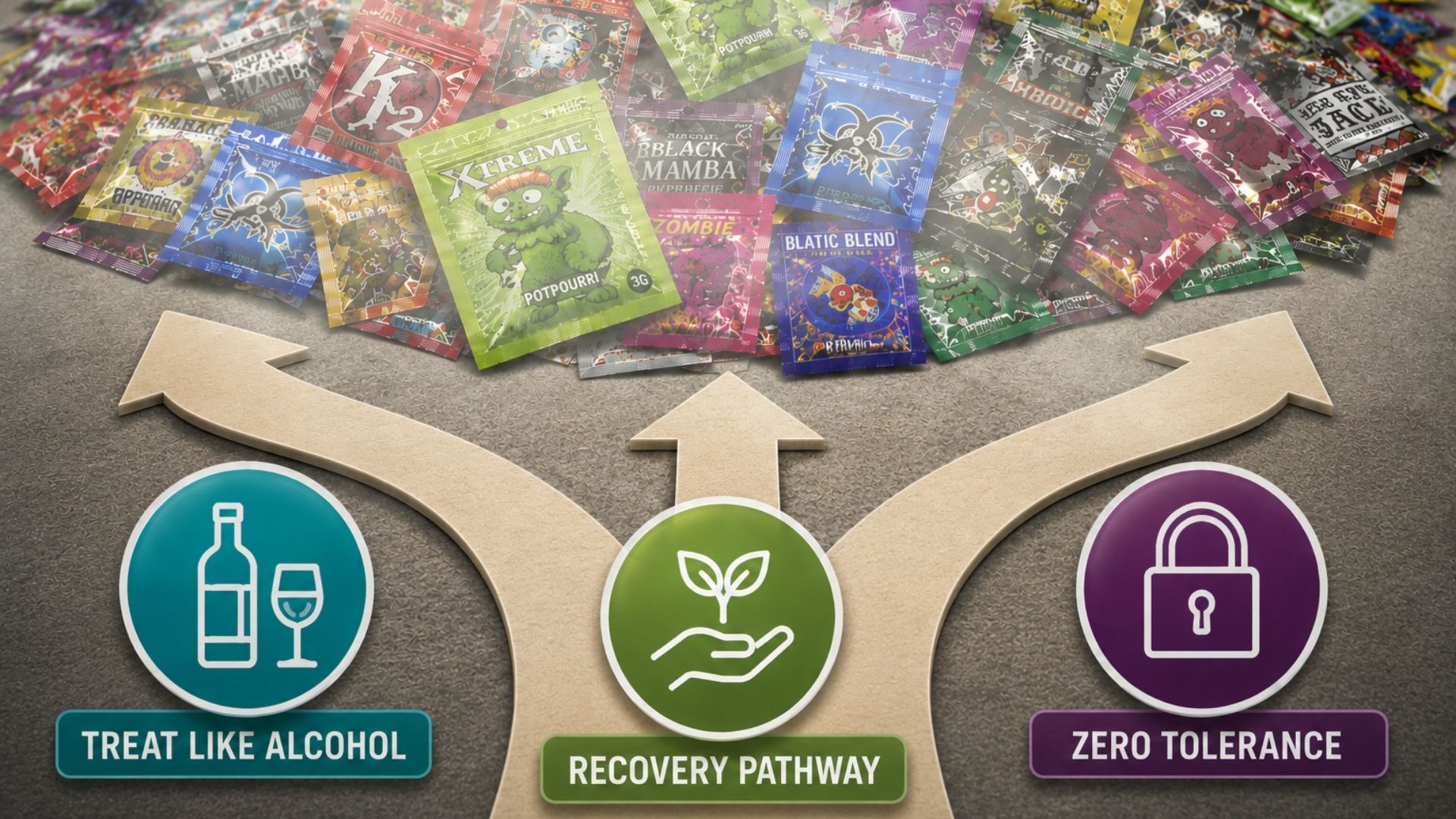 Synthetic cannabinoids, often sold as K2 or Spice, are lab-made chemicals designed to act on the same brain receptors as THC. NIDA states that K2 and Spice can produce stronger effects than marijuana, and an NIH-hosted peer-reviewed article explains that many synthetic cannabinoids are more potent than THC because they activate cannabinoid receptors more fully and intensely. In plain English, this is not just marijuana with a different label. It is engineered to hit harder, and often does.
Why does that matter in maternity housing? Because the fallout is not just behavioral. It can be psychiatric. The CDC warns that synthetic cannabinoids can cause confusion, hallucinations, delusions, psychosis, suicidal thoughts, violent behavior, and problems with concentration. The CDC also notes that these products are unpredictable, with no consistent manufacturing standards, which means two similar-looking packages may contain very different chemicals or doses.
That is why many leaders are rethinking whether and how synthetic marijuana belongs under a standard substance policy at all.
Here are the basic policy approaches I see programs weighing:
- Treat it like alcohol
Residents over 21 may use off-campus, but may not return home under the influence. This is an acknowledgement of the resident’s legal age for consumption and the inability of residential staff to control resident behavior when away from the home. This is simple, familiar, and easy to explain. The weakness is that synthetic cannabinoids are far less predictable than alcohol, and the psychiatric risks can escalate quickly. - Ban alcohol and marijuana entirely
Some programs take the clearest route possible. No alcohol. No marijuana. No synthetic marijuana. This is often easier to enforce and may fit best in homes where stability and safety are already fragile. However, a note of consideration here is that if using this approach, you may deem a large portion of applicants as ineligible for help through your ministry. - Give synthetic marijuana its own category
This may be the most realistic option. It allows a program to keep its existing alcohol or marijuana policy while acknowledging that synthetic cannabinoids carry a different level of risk, especially where psychiatric health is concerned. Homes may accept a resident with pre-existing cannabinoid use but require recovery program participation including daily/weekly 12-step work, individual counseling, and outpatient recovery services. Randomized drug testing is recommended with this approach.
There is also the addiction issue, and it should not be minimized. NIDA says anyone can become addicted to synthetic drugs, and the CDC reports that synthetic cannabinoids can lead to physical and psychological dependence. People who stop after heavy use have reported severe anxiety, trouble sleeping, nausea, vomiting, sweating, rapid heart rate, chest pain, difficulty breathing, and even seizures. So if a resident has been using synthetic marijuana, consequences alone are rarely enough. Recovery work matters.
A practical response usually includes:
- Clear staff language
Define what staff should watch for, such as confusion, paranoia, hallucinations, suicidal talk, agitation, or severe vomiting. - A safety-first response
If a resident appears medically or psychiatrically unstable, the first question is not what consequence to assign. The first question is whether she needs urgent medical evaluation. - A recovery path after the incident
Consider assessment, counseling, treatment referral, relapse planning, and closer support. If addiction is part of the picture, presuming it is merely a discipline problem will not help the resident.
I would also encourage homes to think carefully before defaulting to exclusion whenever cannabinoid addiction enters the picture. Many programs assume they are not equipped to serve these residents, when in reality the core needs are often more practical than specialized. What many women need most is a house that notices what is happening, provides real structure, sets clear expectations, and connects them every day to people who are qualified to help, especially recovery programs and other clinical supports in the community. Not every home is called to every level of care, but many are more capable than they think if they approach the issue with awareness, consistency, and a willingness to build the right outside partnerships.
This is one of those moments when policy needs to be smarter than the street name. Synthetic marijuana may sound familiar, but its effects can be anything but. The goal is not to overreact. The goal is to see clearly, respond calmly, and write policy that deals with the real problem instead of the convenient one.
This article is for informational and training purposes only and is not medical advice.
Sources
- National Institute on Drug Abuse, Mind Matters: The Body’s Response to K2/Spice and Bath Salts
https://nida.nih.gov/research-topics/parents-educators/mind-matter-series/k2-bath-salts - PubMed Central, Synthetic Pot: Not Your Grandfather’s Marijuana
https://pmc.ncbi.nlm.nih.gov/articles/PMC5329767/ - Centers for Disease Control and Prevention, About Synthetic Cannabinoids
https://archive.cdc.gov/www_cdc_gov/nceh/hsb/envepi/outbreaks/sc/About.html - Centers for Disease Control and Prevention, Synthetic Cannabinoids: An Overview for Healthcare Providers
https://archive.cdc.gov/www_cdc_gov/nceh/hsb/envepi/outbreaks/sc/healthcare.html
SAMHSA National Helpline
https://www.samhsa.gov/find-help/helplines/national-helpline
Honoring The Fathers We Don't Always See
This month, we pause to honor fathers and recognize the strength, guidance, and steadfast presence they bring to the lives of their children and families.
Fatherhood is more than a title; it is a calling. It is demonstrated through everyday acts of love, sacrifice, protection, and encouragement. Whether through words of wisdom, quiet support, or simply showing up day after day, fathers help shape identity, build confidence, and leave a lasting impact that extends far beyond a single generation.
We honor the men who invest in their children and families, often in ways that go unseen but are deeply felt. From Heartbeat International, we extend our sincere gratitude to fathers and father figures around the world. May God continue to strengthen and bless you as you influence the lives entrusted to your care.
"Let all that you do be done in love"
~1 Corinthians 16:14~
A Father's Day Gift For You (Devotional)
by Lauri Campbell, LAS, Affiliation Coordinator
As a teen, I went through a season of rebellion that was dishonoring of my parents and my Lord and Savior, Jesus Christ.
When this prodigal very suddenly had that moment of “coming to my senses” (Luke 15:17), I immediately called home and my daddy answered the phone.
As soon as I heard his voice, I began to sob uncontrollably. I knew I had hurt my parents and my God. I was not estranged from my parents, but my heart longed for spiritual restoration, and they welcomed me back with open arms.
 Later, the Holy Spirit convicted me to seek forgiveness from them for those years of rebellion.
When I did, my Dad quickly responded with, “Honey, we did not know all the specifics of your sin, but we forgave you a long time ago.”
And just like that, my earthly father showed me the heart of my Heavenly Father.
I’ve gone back to that holy moment countless times in my life. The longer I live, the more it means to me.
But I realize not everyone has had that experience. Fathers and Father’s Day can bring up different emotions for all of us.
Yet, in Scripture, God is identified as our Father more than 250 times. Most references are in the New Testament, perhaps because in and through Christ, we have a new identity as the adopted children of God (Romans 8:15).
As a Believer, I would submit to you that two of the greatest foundational Truths in Scripture are: God is your good Father and you are His dearly loved child.
Wrapping our heads and hearts around these two statements and standing boldly on them enables the Lord to do a powerful work in and through us. Things change when you know who you are and whose you are.
Jesus says that in seeing Him, we have seen the Father.
“Don’t you know Me, Philip, even after I have been among you such a long time? Anyone who has seen Me has seen the Father. How can you say, ‘Show us the Father’? Don’t you believe that I am in the Father, and that the Father is in Me?” (John 14:9–10)
If you have trouble accepting the unconditional love and forgiveness of your good Father, remember that as you experience the steadfast love, compassion, and tenderness of Jesus, you are actually experiencing your good Father’s love through Christ.
If you know Jesus, you know the Father.
“All those led by God’s Spirit are God’s sons. For you did not receive a spirit of slavery to fall back into fear, but you received the Spirit of adoption, by whom we cry out, ‘Abba, Father!’ The Spirit Himself testifies together with our spirit that we are God’s children…” (Romans 8:14–16)
Paul says, “But you received the Spirit of adoption.” People may give a charter of adoption, but when God adopts you, He has the prerogative (authority and latitude) to give a Spirit of adoption—the nature of children.
And as an adoptee, YOU have received it!
The Spirit of adoption works into the children of God a daughterly or sonly love to God as a Father.
When we don’t “feel” like the beloved children of our good Father, it doesn’t make us any less adopted. The Spirit teaches us in prayer to come to God as a Father, with a holy, humble confidence.
God is your good Father and you are His dearly loved child. Now, that’s worth celebrating!
The Quiet Weight: Men, Abortion, and Fatherhood
by Nyles Pinckney, Men’s Healing Coordinator, Support After Abortion
When people talk about abortion, the focus is usually and understandably centered on women. But there’s another story that may fly under the radar or go unspoken: what men carry and how that experience shapes them as fathers.
For many men, abortion doesn’t stay in the past. Whether they were part of the decision, wanted or didn’t want it, or didn’t know until afterwards, abortion experiences can show up later in how they parent, how they love, and how they even see themselves. And I can attest to that. 
One of the patterns I’ve heard about—and experienced personally, is becoming more protective and aware as a father, sometimes to the point of hovering. On the surface, it looked like deep care and attentiveness. Which it was. But underneath, it was driven by something heavier: my guilt and grief.
I remember moments with my son where I felt anxious or overbearing to the point where I had to pause and ask myself, “Why am I reacting this way?” At a trampoline park once when he was little, he was playing dodgeball. Nothing was particularly wrong, he was having fun, but I felt this urge to step in when I saw kids a bit older jump into the area. To protect him from something that wasn’t even happening. Those kids didn't have any malice or ill will, but I had the urge to jump into action anyway. That’s when I realized I wasn’t just responding to the moment. I was responding to something deeper.
That’s the tension many other men may live with. We love the children we have deeply, but sometimes that love is mixed with a quiet belief: “I have to make up for something.”
This can also show up mentally. In my experience, men can carry an internal pressure to “get everything right” moving forward and may take a perfectionist approach. It becomes a loop: Don’t mess up again. Be better. Be perfect. Over time, that pressure can affect not just how a man parents, but how he relates to his partner. Sometimes we come off as critical or controlling without realizing why.
Emotionally, men often carry this differently. The grief is there, but it doesn’t always come out as sadness. It can show up as frustration, anger, or silence. Those emotions are often more comfortable for men because, from my experience, that’s what we’ve seen and picked up from other men. This can make it seem like men don’t feel deeply, when really a lot of guys just haven’t been given the space or taught the language to express it.
That’s why something as simple as acknowledgment matters. Many men aren’t looking for attention, they just want to be seen and heard. A question like, “How are you doing?” can open a door they didn’t know how to open themselves.
Fear can also linger in the back of our minds. Fear of repeating the past. Fear of future relationships. Fear of whether we’ll handle things differently if faced with that situation again. These are things many men wrestle with internally but rarely say out loud.
The good news is that healing changes things.
When a man begins to process his abortion experience in a healthy way, he becomes more open. He communicates more freely—and not just about the past, but about everyday life. He begins to move away from hovering over his children to actually enjoying them. From controlling outcomes to building connections.
And that shift may not just affect him but benefit the whole family.
If there’s one message I could offer for men in this space, it’s to be gentle with yourself. You don’t have to live defined by guilt or grief. You can be a present, loving father—not out of fear or compensation, but from a genuine place.
And for those supporting men, remember: you don’t need the perfect words. Sometimes the most powerful thing you can offer is your presence, even in silence. Just sitting with him, letting him process, can mean more than trying to fix anything.
Because when men are given space to heal, they become better individually, and they become more present fathers, healthier partners, and stronger foundations for their families.
Nyles Pinckney serves as Men’s Healing Coordinator for Support After Abortion. As a former college athlete, he understands the pressure many men feel to push through pain and keep struggles hidden. He brings that insight to his work supporting individuals impacted by abortion and equipping providers to care well for both women and men.
Honoring Fathers: The Quiet Strength Behind Every Life
Joshua Cheresnick, Support and Growth Specialist, Next Level
Father’s Day is a time to recognize the men who show up, steadfast, present, and often quietly shaping the lives of their children in ways that last for generations. While conversations around pregnancy and parenting often center on mothers, this day offers an opportunity to reflect on the role fathers play in building strong families and supporting life.
Every pregnancy involves more than one person’s experience. Fathers are not bystanders in these moments; they are participants who influence outcomes and, when supported, become advocates for both mother and child. 
The Impact of the Engaged Father
Research consistently shows that children with engaged fathers tend to fare better emotionally, academically, and socially. A father’s presence can provide stability, encouragement, and a stronger sense of identity. Beyond the data, there is something deeply human about a man choosing to step in, learn, and grow, especially in circumstances that are unexpected or uncertain.
For many men, an unplanned pregnancy can bring fear, confusion, and uncertainty about what comes next. Without support or guidance, it can feel easier to withdraw than to engage. This is where pregnancy help organizations play a critical role—not only for mothers, but for fathers as well—creating space for men to ask questions, find support, and understand their role from the beginning.
Meeting Fathers Where They Are
There is a growing recognition that engaging fathers is essential. When fathers are welcomed, heard, and equipped, the impact extends far beyond a single interaction.
This can include:
- Creating space for fathers in appointments and conversations
- Offering mentorship or fatherhood programs
- Providing practical resources and education
- Communicating their value and role in the process
Sometimes, what a father needs most is simple: someone who believes he can rise to the moment.
Redefining Strength
Cultural narratives around fatherhood can be mixed. Strength is often associated with independence or emotional distance. Yet real strength is found in presence, humility, and commitment.
Strength is:
- The father who chooses to stay.
- The father who learns, even when he feels unprepared.
- The father who supports the mother of his child with respect and care.
- The father who grows into his role over time.
These are men worth recognizing.
A Call to Encourage and Equip
This Father’s Day, pregnancy help organizations are encouraged to intentionally recognize and engage the fathers in their communities. A word of encouragement, a simple invitation, or a program designed for dads can open the door to meaningful change—not only for one man, but for an entire family.
Let’s continue building environments where fathers are not overlooked, but supported; not sidelined, but equipped. Where men facing fatherhood—planned or unplanned—know they are not alone.
When fathers are empowered, families are strengthened, and lives are forever changed.