
Savonne Torain
Greetings From Ellen
Thank You and Happy Mother's Day from Heartbeat International
This month, we pause to honor mothers and recognize the strength, sacrifice, and faithfulness so often lived out in quiet ways.
Motherhood—whether biological, adoptive, or foster—is not simply a role; it is a calling. It is formed through sacrifice, shaped by perseverance, and lived out in daily, often unseen acts of faithfulness. These are the very qualities that strengthen families and, ultimately, communities.
We honor those who continually remind us through their choices and everyday giving that the greatest expressions of love are rarely convenient. From Heartbeat International, we extend our deepest thanks to mothers around the world. May God continue to bless you and your family with His favor.
"Her children rise up and call her blessed."
~ Proverbs 31:28 ~
Remembered, Honored, and Called (Devotional)
by Michele Cheresnick, LAS, Affiliation Coordinator
This month, we pause to honor mothers and recognize the strength, sacrifice, and faithfulness so often lived out in quiet ways.
Motherhood—whether biological, adoptive, or foster—is not just a role, it is a calling. It is formed in sacrifice, shaped by perseverance, and lived out in daily, often unseen faithfulness. These are the very qualities that strengthen families and, ultimately, communities.
Memorial Day reminds us that sacrifice is not abstract—it is real, and it is costly. We honor those who gave their lives in service, and in doing so, we are reminded that the greatest expressions of love are rarely convenient. They require something of us.
That same truth is evident in foster care. Families who step into that space are choosing to show up in the middle of uncertainty. They are not stepping into perfect situations—they are stepping into need. And that willingness matters.
This is where our work intersects.
In the Pregnancy Help Ministry, we meet people at critical moments—moments that will shape not only a decision, but a future. What we do in those moments matters. How we show up matters. We are not simply offering services; we are creating an environment where courage is possible, where truth is communicated with compassion, and where no one has to navigate that moment alone.
We also recognize that for many, this month is not simple. Mother’s Day can carry grief. There are those who come through our doors—and those who serve alongside us—who hold complicated stories. That reality should not be overlooked. It should sharpen our awareness and deepen our care.
So as we move through this month, let’s be clear about who we are and what we are called to do.
We remember well.
We honor sacrifice.
We lead, with a steady, compassionate presence.
Honoring Her: Seeing the Courage, Dignity, and Love of a Birthmother
by Robin Stephenson, Founder and Director, Lifetree Adoption Agency
The love of a Birthmother is not always easy to comprehend. It is a love that struggles, questions, hopes, and hurts at the same time. Yet this love is special. It speaks to something sacred.
To honor a Birthmother is to truly see her.
Not just the decision she made, but the courage it required.
Not just the moment of placement, but the journey she walked to get there.
Not just the results of her choice, but her heart.
There are certain times of the year when things feel heavier—Mother’s Day, birthdays, anniversaries, or even unexpected moments that bring emotions back to the surface. A Birthmother may feel peace, sorrow, joy, and reflection all at once. These emotions do not cancel each other out. They can exist together, shaping a story that is both tender and strong.
And that is okay.
Scripture tells us, “The Lord is close to the brokenhearted and saves those who are crushed in spirit” (Psalm 34:18). This reminds us of the care and compassion we are called to show. When we honor a Birthmother, we reflect the nearness of God—not through assumptions, but through understanding.
A Birthmother’s courage is often quiet.
We may expect courage to look loud or bold, but sometimes it is seen in her willingness to carry life while facing difficult questions and circumstances of her own. It is found in the moment she chooses what she believes is best for her child, even when that choice comes at a great personal cost. This kind of courage does not make her weak; it reveals her strength. It does not steal her dignity; it reflects it.
She is not defined by one moment in her life. Being a Birthmother is only part of her story, but it is not her whole story. She is a woman with a voice, a beautiful story, and a love that continues long after placement. To honor her means recognizing that her story matters—not only in the life of the child, but in her life too.
Often in our ministries, we tend to focus only on the outcome. But honoring a Birthmother calls us to slow down and look deeper. Behind every adoption story is a woman who has carried something deeply meaningful.
The Bible says, “Carry each other’s burdens, and in this way you will fulfill the law of Christ” (Galatians 6:2). When we listen to her story, honor her emotions, and recognize her courage, we begin to see her more clearly and walk alongside her with compassion and humility.
A Birthmother’s story does not end after placement.
It keeps growing.
There can be healing. There can be joy—not a superficial joy, but one rooted in peace and purpose. Over time, what once felt overwhelming can become a place of strength. Her story may become a source of encouragement to others, a reminder that even in complex and emotional seasons, love can still lead with courage, grace, and hope.
Romans 8:28 reminds us that “in all things God works for the good of those who love Him.” This promise does not dismiss the difficulty of her journey, but it affirms that her story has meaning and purpose.
To honor a Birthmother is to make space for all of this. It means speaking of her with respect, acknowledging her bravery and the strength it took without minimizing the sacrifice she made. It means affirming her dignity in every season and recognizing that her love did not end; it transformed.
When we take the time to truly see her, our hearts change. We stop seeing her as someone we are simply serving, and we begin to honor the woman behind the story. When she feels honored, she is reminded that she has not been forgotten. Her story matters. Her life matters. And the love she carries still matters.
In honoring a Birthmother, we reflect the heart of God—a heart that is compassionate, attentive, and full of love.
And when we do that, we honor the true heart of adoption. We see the Birthmother beyond the moment of placement and recognize the courage, dignity, and love woven throughout her story. Her love was never small. It was sacred, and it will always matter.
Watch Robin share more about "Honoring Her Story" on the Pregnancy Help Podcast. Click here to view.
Broken Shoe
by Andrea Trudden, Vice President, Communications and Marketing 
It was the second day of conference when a small, inconvenient moment became a clear reminder of how quickly God provides.
I had just stepped out of a general session when my shoe suddenly broke. The strap snapped clean through. There was no fixing it. I slipped it off, a bit stunned, trying to figure out what to do next. Almost immediately, a friend and exhibitor called out to check on me. All I could say was, “My shoe just broke!”
Without hesitation, she responded, “I have an extra pair in my bag. Come over.”
Less than 30 seconds later, I had a new pair of shoes. (Thank you, Angie!)
It was such a simple moment, but it was unmistakable. God had already made provision before I even knew I would need it. In a quiet hallway, during a time when most people were in the keynote session, the right person was in the right place, with exactly what was needed.
Scripture reminds us of this truth so clearly: “And my God will supply every need of yours according to his riches in glory in Christ Jesus.” (Philippians 4:19)
Those shoes were not a perfect fit. To be honest, they were a little small, but they were comfortable enough and carried me through the rest of the day. And more than that, they carried a deeper reminder that God’s provision is not always extravagant, but it is always sufficient.
“But he said to me, ‘My grace is sufficient for you, for my power is made perfect in weakness.’” (2 Corinthians 12:9)
Had my friend not been there, I would have spent the next half hour walking barefoot back to the hotel, changing, and returning, missing valuable time and likely drawing more attention than I preferred. Instead, God made a way in an instant.
That night, I held up that broken shoe in our staff meeting as a simple testimony. What could have been a frustrating inconvenience became a tangible example of God’s care. It sparked a conversation about what it means to walk together as the Body of Christ.
One colleague said something that stayed with me: “We truly are a tribe in this movement.” She noted that so many others would have done the exact same thing. And she is right. The pregnancy help community truly reflects the heart of Christ in how we care for one another, often in the smallest, most practical ways.
God’s provision does not always come in dramatic ways. Sometimes it looks like a spare pair of shoes. Sometimes it is a friend who is paying attention. Sometimes it is simply being in the right place at the right time.
But it is always Him.
And once you start noticing it, you begin to see it everywhere.
For those serving in pregnancy help, this truth is not just encouraging, it is sustaining. Each day, you meet women and families in moments of uncertainty, fear, and urgency. Needs arise quickly, and answers are not always immediately visible. Yet this small moment is a reminder that God is already at work ahead of you.
He is preparing conversations before they happen. He is positioning people and resources before the need is spoken. He is making a way, even when circumstances feel fragile or unexpected.
Just as He provided something as simple as a pair of shoes at exactly the right time, He will continue to provide wisdom, compassion, resources, and strength for every life you encounter.
“And God is able to bless you abundantly, so that in all things at all times, having all that you need, you will abound in every good work.” (2 Corinthians 9:8)
His provision is often found in everyday moments. A timely word. A volunteer who shows up. A donor who gives. A client who pauses long enough to listen. These are not coincidences. They are evidence of His care.
So take heart. The same God who meets small needs in quiet hallways is the God who is faithfully working through you to meet much greater ones.
Thank You for Answering the Lord's Assignment
by Christa Brown, APRN Executive Director
It can be a very dark place when a woman has given in to the pressures, made the purchase, swallowed that first pill, then immediately has deep regret.
Where does she find the courage to seek help to continue her pregnancy? How does she find the bravery to turn in another direction, even while surrounded by challenging circumstances and influencers telling her that abortion is the only way?
In that moment she’s lost her power and strength as a woman and needs a voice of hope to help her be brave.
What causes a busy physician to set aside time to help these women they’ve never met before? Miraculously, a few minutes and a simple prescription of progesterone can save a life and spare a mother a lifetime of heartbreak.
A battle persists to stop these connections from ever happening. But there is a bold and determined army who have each accepted their assignment from the Lord.
This includes the women who make that courageous call; the OptionLine team who first speak with the woman and provide the first sign of hope; and the APR hotline nurse, who not only shares information, but also compassion and a glimmer of light in her darkest hour.
But without those who prescribe progesterone, no reversals would occur, no lives saved. 8,000 hearts would not beat.
Those who prescribe APR boldly say “I can be the one! I can stand in the gap between life and death!” They fully understand that in every pregnancy there are two patients, two heartbeats and two lives to be considered and cared for.
And with this divinely guided team, the miracles continue one at a time. We’ve helped in all 50 states in the U.S. and in 98 other countries saving thousands of lives - all while faced with intense battles. This team refuses to turn back.
Today we thank the Lord for each of you who have said “yes” and give women and families the last chance to choose life for their precious children.
Ultrasound Refresher Opportunities Available!

While there are various ultrasound training options available for nurses and sonographers who work within the pregnancy help movement, Heartbeat International has championed a new form of training that connects the technical needs and the spiritual needs for those working in pregnancy help.
For the medical professional looking for an ultrasound refresher, we have options!
The LOVE Approach Ultrasound Clinical (LAUC) provides a high volume of scans with the inclusion of spiritual components surrounding the client conversation and encouragement of the medical professional through fellowship with other like-minded medical professionals serving in the same capacity. We are in this together!
Online Limited Obstetrical Refresher Course to enhance the skills of nurses and sonographers within the pregnancy help community currently performing limited obstetric ultrasound. Available in a convenient and easily accessible on-demand format, the didactic portions of the training can be completed on your own schedule over a six-month period.
Monthly Image Review Sessions for those who have completed the Online Limited Obstetrical Refresher Course and/or the Online Didactic Ultrasound training. Each image review is a monthly discussion and includes a case study examination. This unique opportunity also provides live Q&A with Tammy Stearns and Christa Brown.

Retention Rate following LOVE Approach ultrasound clinical:
- Post-event surveys show that 98% continue to work in their pregnancy help medical clinics for at least six months after the training.
- After one year, 94% of attendees continue in their clinic roles with an average confidence level of 4.4/5.
- 100% of attendees said they left the training with tangible ways to enhance their ministry’s effectiveness.

Constructive Artifacts in Ultrasound
by Tammy Stearns, MS, RDMS, RVT, RT(R), FSDMS, FAIUM, LAS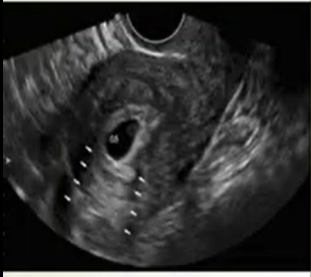
Often when one hears the term artifact, there is the reactionary thought of how to correct it, eliminate it and make it disappear. However, in ultrasound certain artifacts can be useful to the imager and contribute to the information gleaned from the exam. If utilized well, certain artifacts help to determine the composition of the structure, the technical features of the exam, and the direction in which the imager should follow while imaging.
Basic Properties of Sound
The physical properties of sound, how it traverses the body, and ultimately contribute to the composition of the image on the ultrasound screen, is daily utilized by imagers to help determine the structures being imaged. The basic parameters of imaging with sound include the transmission of waves by a transducer which react with the body’s tissues to create images based on acoustic impedance, reflection, scattering, and attenuation. The type of interaction that occurs is dependent on the stiffness and density of the structures that it encounters. As the sound beam travels through the body, it weakens in accordance with the composition of the structures in which it traverses. The portion of the beam that bounces back to the transducer is then converted into a level of white, black, or various shades of gray, dependent on the intensity of the received sound beam in comparison to the sound beam that was transmitted. Weaker signals are blacker while strong signals are brighter or white.
Helpful Artifacts
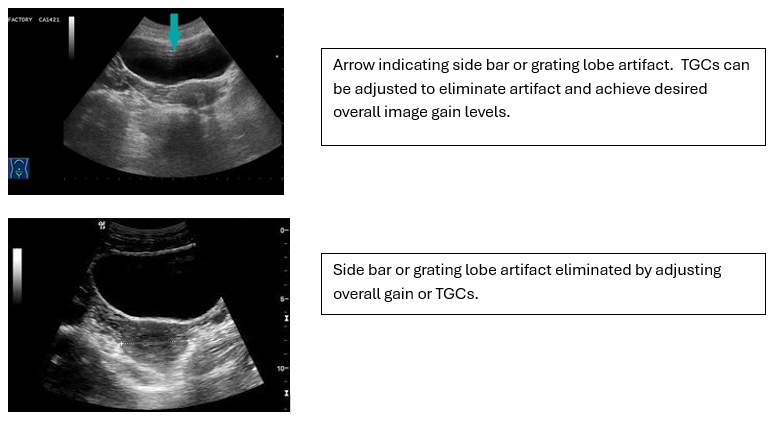
The Side Lobe or Grating artifact can often be found in the full bladder, which is necessary to scan a transabdominal pelvis. The interface of the bladder wall and the fluid within the bladder creates conditions that cause the sound beam to create what appears to be white or echogenic (white) lines across the anterior portion of the bladder. They are typically faint and can extend beyond the bladder wall. They are not consistent in their presence or appearance as the structure is imaged in two planes, nor do they remain as the bladder is emptied or when the patient changes positions, thus confirming they are artifact by nature. While they can be degrading to the overall appearance of the image, they provide a reference as to how to adjust the overall gain of the image. This can be accomplished by adjusting the overall gain or moving the TGCs inward. By knowing that they are simply artifacts, the imager can utilize them as a guide to darken the image by decreasing the gain until they are no longer visible.
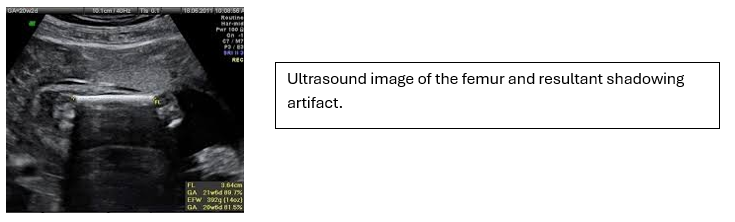
Shadowing occurs when an object has a significant attention coefficient that results in the sound beam hitting the object and instead of passing through the object, the sound beam bounces directly back. This results in the structure posterior to the object to not be imaged or displayed on the ultrasound screen due to lack of information gained. An example would be the femur length. The sound beam will travel to the femur, a hard bone with high levels of stiffness and density, hit the bone and bounce back to the transducer. Everything posterior to the femur is not imaged due to the sound beam not being able to pass by the femur itself. This provides the imager with the information that this structure has a significant level of stiffness and density confirming, most often, that it is either bone or a significant calcification. This is not an artifact that needs to be minimized or eliminated yet is utilized to help in the imaging process. If it is necessary to image the structures directly posterior to the structure that are obscured by the shadowing, scanning at a different angle or through a different sonographic window can be helpful.
Posterior Acoustic Enhancement is an artifact that provides information regarding the cystic nature of the structure. As the sound beam travels through the body, it is attenuated at different levels dependent on the structure through which it is traveling. The attenuation rate is determined by the level of stiffness and density of the structure. Whereas shadowing is caused by the great level of attenuation of high level of stiffness and density in bone, a structure that is cystic allows the sound beam to travel through with less attenuation than the soft tissue that surrounds it which results in the area directly posterior to the structure to be brighter than the adjacent soft tissue. This allows the imager to differentiate between structures as being soft tissue masses or cystic (fluid-filled). Certain masses can appear to be cystic due to their hypoechoic or almost anechoic (black) appearance, however, without demonstrating posterior acoustic enhancement (brightness or white appearance directly posterior), it can be determined that they are not fluid-filled because of the attenuation that has traveled through the structure is the same as the adjacent soft tissue. However, a structure with the same appearance as a soft tissue mass can be determined to be cystic or have significant cystic components as it demonstrates posterior acoustic enhancement or brightness posterior to the structure.
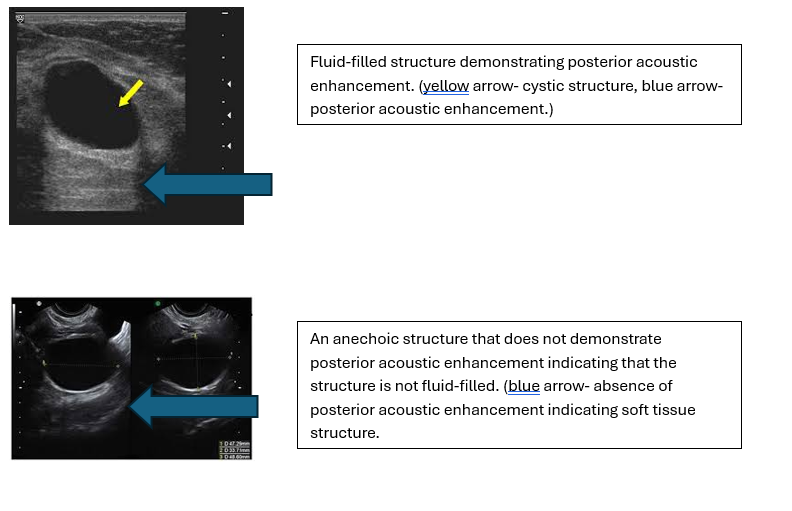
By recognizing and utilizing the information obtained with artifacts that are helpful to the imager can determine whether structures are cystic, soft tissue, or bone. The artifacts can also help the imager determine the level of darkness necessary regarding the overall image appearance on the ultrasound screen. While there are artifacts that can lead to image degradation and need to be eliminated, the artifacts that offer key information are invaluable to the imaging process.
Patient Outcomes Influenced by Thoughts
by Brooke Myrick, BSN, RN, LAS
The power of the mind and the impact of the thoughts generated by the mind are more significant than most believe. As it is widely agreed that anxiety, worry, and stress are not optimal health choices, the extent to which these choices influence one’s health trajectory is receiving increased consideration.
In the Yale Journal of Biology and Medicine, the connection of healthcare professionals choosing to provide care and support with the incorporation of holistic strategies, including a positive mindset in patient outcomes, is carefully discussed by Angel D. Prabakar in The Power of Thought: The Role of Psychological Attentiveness and Emotional Support in Patient Trajectories.
Holistic care can be defined as seeking to treat the individual as a whole - encompassing physical, emotional, social, and spiritual health.
Incorporating holistic care into medical services can improve patient outcomes.
In the Pregnancy Help Medical Clinic (PHMC), the best and healthiest outcome for all women and families being served should always remain steadfast and at the forefront of each interaction and medical service provided by the clinic's medical professionals. The PHMC medical professional could be one of the first to express positive support filled with genuine love and care to the patient/client, instilling in them the confidence that a positive outcome is possible for their life.
Prabakar found in his case studies that when a patient is more involved in their healthcare, they will also be more motivated to comply with their plan of care. Additionally, when the patient incorporates positivity into their thoughts and mindset by remaining hopeful, these actions tend to correlate to a more positive result.
It is worth noting that Prabakar also makes mention of the impact of strong social support, coping mechanisms, and life experiences, findings cited in the National Library of Medicine that greatly influence a patient’s ability to maintain a positive mindset, which also increases the likelihood of healthier behaviors.
As we know, before any science or case studies, God’s word existed. He has been teaching and instructing us from the very beginning to trust Him. When we follow his commands, we receive a blessing. When we choose not to follow his commands, we are outside of his best for us and have varying consequences.
God provides instructions about thoughts and the mind in The Holy Scriptures because He created us and knows the impact our thoughts and minds have on our mind, body, and even our soul. There are many scriptures provided to us that specifically emphasize the power of the mind and the blessing of hope and rest when we choose to trust Him.
Finally, brothers, whatever is true, whatever is honorable, whatever is just, whatever is pure, whatever is lovely, whatever is commendable, if there is any excellence, if there is anything worthy of praise, think about these things. Philippians 4:8
…casting all your anxieties on him, because he cares for you. 1 Peter 5:6-7
May the God of hope fill you with all joy and peace in believing, so that by the power of the Holy Spirit you may abound in hope. Romans 15:13
Do not be conformed to this world,[a] but be transformed by the renewal of your mind, that by testing you may discern what is the will of God, what is good and acceptable and perfect. Romans 12:2
Set your minds on things that are above, not on things that are on earth. Colossians 3:2
...take every thought captive to obey Christ. 2 Corinthians 10:5
As we speak with our patients/clients in the Pregnancy Help Medical Clinic about their health circumstances and life choices, we can incorporate recent findings concerning the impact of a positive mindset while we also share God’s truths. After all, one of the greatest blessings of being a medical professional within the PHMC is the gift of being sent out to share the gospel of Jesus Christ and the hope that can only be found in Him.
I came that they may have life and have it abundantly. John 10:10b
For I delivered to you as of first importance what I also received: that Christ died for our sins in accordance with the Scriptures, that he was buried, that he was raised on the third day in accordance with the Scriptures. 1 Corinthians 15:3-4
As followers of Jesus Christ seeking to know Him, and being commissioned to make Him known as medical professionals within the PHMC, we should read, study, and memorize God’s words so that we can live them out and put them into action in deed and in truth, as we serve those seeking our help.
Little children, let us not love in word or talk but in deed and in truth. 1 John 3:18
But be doers of the word, and not hearers only, deceiving yourselves. James 1:22
Within the PHMC, we also have the opportunity and privilege of incorporating holistic medical care and support, for the whole woman, as we learn about her physical, emotional, social, and spiritual circumstances.
This holistic care and these biblical truths are provided when the L.O.V.E. Approach is included in the medical services. This biblical approach of listening and learning, discussing open options, sharing vision and value, and extending help and empowering her to follow through, provides care to the whole woman. This process includes the patient/client in their care, options, and vision, which in turn, could lead to increased follow through and compliance.
Medical care within the Pregnancy Help Medical Clinic is uniquely orchestrated in such a way that as she receives medical care, she is also receiving strong support, coping mechanisms rooted in Christ, and positive life experiences set apart from her encounters in the world.
Our prayer for you is Hebrews 10:23, Let us hold fast the confession of our hope without wavering, for he who promised is faithful.
The Medical Impact team appreciates all you are doing for life for His name’s sake. As you consider providing holistic care to the whole woman you are serving, we are here to support you, encourage you, help you, and pray for you. We would love to hear from you! You can reach our team at This email address is being protected from spambots. You need JavaScript enabled to view it.. May the Lord bless you and keep you!
When Good Teams Disagree: How to Navigate Hard Resident Situations with Wisdom and Integrity
by Valerie Harkins, Executive Director, Maternity Housing Coalition 
Why Disagreement Is Not a Sign of Failure
Any organization that does meaningful work long enough will eventually face an uncomfortable but unavoidable reality: thoughtful, committed people will sometimes disagree about what should be done.
In maternity housing, those disagreements often arise at precisely the moments that matter most. A resident’s behavior may raise concerns about safety, accountability, community standards, trauma, or fairness. One staff member may feel the situation requires a firm boundary. Another may believe the behavior reflects distress rather than defiance. A third may worry about what message the decision will send to other residents. None of those instincts is necessarily wrong. In fact, the presence of competing concerns is often evidence that people are taking both the resident and the mission seriously.
We should stop treating disagreement as a sign of dysfunction. Very often, it is a sign of health.
A team that never disagrees may not be united; it may simply be unexamined. In a healthy organization, people bring different experiences, convictions, and discernment to the table. That can create friction, but friction is not always a threat. Sometimes it is the very thing that keeps us from making shallow decisions. As the saying goes, when we pray for rain, we should expect mud. If we ask God to grow a ministry, deepen its impact, and entrust us with vulnerable lives, we should not be surprised when some of the work becomes difficult to navigate. Ministry is sacred, but it is rarely neat.
Start with the Mission, Not the Rulebook
So what should a team do when it cannot agree on how to respond to a resident’s behavior or circumstances?
The first step is to resist the instinct to run immediately to the rules. Begin with the mission, not the program handbook.
That distinction matters more than many leaders realize. Policies and procedures are essential, but they are not the heart of the organization. They are tools meant to serve the mission, not substitutes for it. In moments of conflict, teams can become overly procedural, reaching for policy language as though it alone can answer moral, relational, and organizational questions. But before asking, “What does the rule say?” a wiser question is, “Why do we exist?” What is the organization called to protect, cultivate, and offer? What are we fundamentally here to do? When a team reorients itself to mission, it is far more likely to make a decision marked by both clarity and integrity.
Separate Facts from Emotion
After that, the group must review the facts of the circumstance as plainly and soberly as possible. This requires discipline.
Difficult resident situations generate strong emotions, and understandably so. Staff members may feel disappointed, protective, frustrated, fearful, or heartsick. Those emotions are real, and they should not be mocked or dismissed. But they must not be allowed to dominate the process. Good discernment depends on the ability to separate what is known from what is assumed, what is documented from what is inferred, and what actually occurred from the emotional atmosphere surrounding it. The question is not how the situation feels in the room; the question is what is true.
For Faith-Based Organizations, Pause to Pray
For faith-based organizations, this is also the moment to pause and pray together.
Not performatively. Not as a spiritual courtesy before continuing with a decision already made in everyone’s mind. Pray because wisdom is needed. Pray because human judgment is limited. Pray because leadership, especially in complex and emotionally charged situations, requires more than policy knowledge and professional instinct.
Invite the Holy Spirit to guide the conversation. Ask for discernment, humility, restraint, and unity. Ask to see the resident clearly, and to see yourselves clearly as well. Prayer does not always remove complexity, but it often changes the quality of attention we bring to it. That alone can alter the course of a conversation.
Take an Honest Inventory of Resources
From there, the team must turn to the practical question of resources. Even when a compassionate or creative response seems possible, the organization must ask whether it can responsibly sustain it.
Do we have the time? Do we have the staffing capacity? Do we have the financial margin? Could this situation be managed well, even if doing so stretches beyond ordinary program norms? These are not cynical questions. They are necessary ones. It is not merciful to promise what an organization cannot faithfully carry. Mature compassion is not simply generous in spirit; it is honest about capacity.
Ask Whether the Response Still Aligns with the Mission
This is where many leadership teams make their most important distinction. The issue is not merely whether something can be done. The issue is whether it should be done in a way that remains aligned with the mission.
Some circumstances fall outside normal expectations yet still represent a meaningful and mission-consistent opportunity to serve. There are also circumstances in which continuing to intervene may no longer reflect wise stewardship of the organization’s calling, people, or resources. The aim is not to protect institutional comfort. Nor is it to stretch grace beyond the point of responsibility. The aim is faithful alignment.
When Consensus Cannot Be Reached
And then comes the final, often overlooked principle: if the group still cannot reach a unified and collegial consensus, the matter should be escalated to the director for a final decision.
That is not a breakdown in the process. It is part of the process.
Healthy organizations do not require unanimous instinct; they require clear leadership. A team may do all the right things—return to mission, clarify the facts, pray, assess resources, deliberate thoughtfully—and still remain divided. At that point, someone must be entrusted to make the final call. That is one of the burdens of leadership.
Support the Final Decision
But once that decision is made, the team has a responsibility to support it, provided it does not bring harm to the resident or to staff.
Internal disagreement should not become ongoing internal sabotage. A team can hold differing personal views and still choose institutional solidarity. In fact, that kind of maturity is one of the marks of a trustworthy ministry.
This is especially important in maternity housing, where staff are constantly asked to hold compassion and structure in the same pair of hands. That tension does not disappear with experience. If anything, the longer one serves, the more one understands how rarely difficult situations fit neatly into policy language. But that does not mean the work becomes arbitrary. It means the work requires wisdom. It requires moral seriousness. It requires the kind of leadership culture in which disagreement is neither feared nor indulged, but carefully stewarded.
A Final Word
The strongest teams are not the ones that avoid hard conversations. They are the ones that know how to have them without losing their center.
Disagreement, in itself, is not the enemy. The real danger is a team that forgets who it is, why it exists, and how it is meant to lead when the path is unclear. If we can remain anchored in mission, honest about facts, dependent on God, realistic about resources, and respectful of leadership authority, then even our most difficult internal disagreements can become occasions for deeper clarity and stronger unity.
And that, too, is part of faithful ministry.