
Savonne Torain
Women's History Month 2026

Honoring women who are leading the way in pregnancy help around the world. Celebrating the compassionate leaders, faithful advocates, and courageous pioneers who are serving women and families every day—one organization, one community, and one life at a time worldwide
Purim: A Call To Prayer
by Michele Cheresnick, LAS, Affiliation Services Coordinator
Purim, the celebration of deliverance in the Book of Esther, has just passed. It reminds us that God works even when He seems hidden. It's a time to remember how God saved His people from destruction in Persia. A story of dramatic reversal: a death decree overturned, mourning turned into joy, fear replaced with feasting.
But before the celebration, there was prayer.
When Esther learned of the threat against her people, she called for fasting. Before she approached the king, she sought God. Though His name is never mentioned in the book, His presence is unmistakable. The victory began in a hidden surrender.
Purim reminds us that deliverance is often born in prayer.
As Christians, we see the greater fulfillment in Jesus Christ. Before the cross, Jesus prayed. Before resurrection joy, there was surrender in the garden. Our greatest reversal — from sin to salvation — flowed through prayerful obedience.
Now that Purim has passed, the invitation remains:
- Pray in crisis.
- Pray in calm.
- Pray when God seems silent.
The God who reversed the decree still hears. And He still moves when His people pray.
Juggling Glass and Rubber
by Andrea Trudden, Vice President of Communications and Marketing
Those who serve in pregnancy help rarely have quiet days. Phones ring. Clients arrive. Volunteers need direction. Donors need updates. Reports wait to be written. Somewhere in the middle of all of it, you are also a spouse, a parent, a friend, a church member, a ministry leader, and a person with a body and soul that require care. If you’re honest, you may even feel like you’re running a small logistics operation: family schedules, work deadlines, church commitments, kids’ activities, aging parents, community needs, and yes, self-care. It can feel like living in a constant juggling act.
There is a leadership metaphor that has endured for decades because it rings true. It’s often attributed to Brian Dyson, a former CEO of Coca-Cola, who is frequently credited with popularizing the “rubber balls and glass balls” illustration in a 1991 commencement address. The image is simple: you are always juggling. Some balls are rubber. If you drop them, they bounce. Others are glass. If you drop them, they crack, chip, or shatter. The lesson is not that you should juggle better. The lesson is that you should juggle wiser.
I first heard this metaphor in a deeply personal way last July. A friend on our prayer team at Pregnancy Help Institute told me she felt prompted to come over and shared this very image. She spoke about rubber balls and glass balls and gently reminded me to be careful about which ones I was trying so hard to keep in the air. That moment has stayed with me ever since. (Thank you, Jenny!)
Those working in pregnancy help, especially, are vulnerable to believing every ball is glass. The mission is urgent. The needs are immediate. The stories are heavy. When women face pressure, fear, or coercion, you can feel the weight of their situation after hours. That urgency can quietly convince you that you cannot let anything fall, ever.
But God does not ask you to be everywhere at once. He asks you to be faithful with what He has entrusted to you today.
Scripture gently reorders our priorities. In Luke 10:41–42, Jesus speaks to Martha, overwhelmed with serving: “Martha, Martha, you are anxious and troubled about many things, but one thing is necessary.”
Martha wasn’t doing a bad thing. She was doing many good things, all at the same time, and her soul was fraying. Jesus was not condemning service. He was calling her back to what mattered most.
That matters for us because pregnancy help is, by nature, a “many good things” calling.
Work may be one ball, but it’s connected to others. Family is not a sidebar to your ministry. Church is not an optional add-on. Activities and commitments, even good ones, can multiply until your calendar becomes your master. And self-care, though sometimes dismissed as indulgent, is often the simple stewardship of the body and mind God gave you.
So, how do we tell the difference between rubber and glass?
Start by naming your current “juggle.” For many in pregnancy help, it looks like this:
- Work: clients, staff care, volunteer training, fundraising, compliance, crisis response
- Family: spouse, children, household needs, elderly relatives, family rhythms
- Church: worship, small group, serving roles, spiritual leadership at home
- Activities: school events, sports, community responsibilities, friendships
- Self-care: sleep, nutrition, movement, counseling, quiet, sabbath, medical care
Now ask: which of these are glass for you right now?
Often, the “glass balls” include your relationship with God, your marriage, your children, your integrity, your health, and the trust of your team. When those crack, they take far longer to restore. Many leaders discover too late that neglecting sleep, skipping time with God, or living on adrenaline does not simply “bounce back.” It eventually incurs a cost.
Rubber balls are usually the things that can pause and recover without permanent harm: a less-than-perfect inbox, a delayed non-urgent project, a meeting that can be rescheduled, a volunteer task that can wait, a social commitment you can decline, a homemade dinner that becomes sandwiches. Rubber isn’t unimportant. It just means it can hit the ground and still return.
Here’s the permission many of us need: it is okay to let the rubber balls bounce.
That may mean choosing to leave work on time two nights a week so your family consistently gets you. Or saying “not this season” to an additional church responsibility, even if it’s a good one, because your first ministry is faithfulness where you already are. It could be stepping back from a child’s extra activity when your home needs you more. Or simply turning off your phone for a set hour, not because you don’t care, but because you do. And (the hardest at times) embracing self-care as stewardship: taking a walk, getting to bed, having a date night, seeing a doctor, practicing a true sabbath.
This is not selfishness. It is wisdom.
And here is the second truth: you can do it alone, but you don’t have to.
Pregnancy help work was never designed to be carried by one person’s strength. Galatians 6:2 calls us to “bear one another’s burdens, and so fulfill the law of Christ.”
That is not only for the women you serve; it is for you and your team.
Moses learned this the hard way. When the weight of leadership was too heavy, Jethro urged him to share the load, appointing others to help carry responsibility (Exodus 18). Even Jesus sent His disciples out two by two.
So ask for help without apology. Delegate. Train. Invite others to carry real responsibility, not just busywork. Let someone else answer the phone for an hour while you regain your bearings. Bring a trusted friend into your burdens in prayer. If you are in leadership, model healthy limits so your team knows they are allowed to be human, too.
The women and families you serve do not need you to be limitless. They need you to be faithful, steady, and whole.
You will keep juggling. That is life. But today, you can choose to juggle with discernment: let the rubber balls bounce, protect the glass ones, and remember you were never meant to carry this calling alone. God’s grace is not only for your clients. It is for you, too.
Nourish Your Soul: The Power of Rest and Learning
by Kathy Jerman, Director of Affiliate Services
In the pregnancy help movement, the needs never stop.
The phones keep ringing. The clients keep coming. The emails keep piling up. And for many of us, the weight of leadership, limited resources, and the spiritual intensity of this work can quietly drain our reserves. We pour out every day. But even those who are called must be filled.
As we approach our Annual Conference in Cincinnati at the end of the month, I want to gently encourage you to view this gathering not simply as professional development, but as soul care.
Rest Is Not a Luxury - It’s a Necessity
In pregnancy help ministry, stepping away can feel indulgent or even irresponsible. There is always more to do. But the truth is, you cannot sustainably lead from depletion. Time away is stewardship of your calling.
When you take a few days to step out of the daily demands of your center, you give yourself space to breathe deeply, listen more clearly to the Lord, reanchor your heart in God’s calling, and be reminded that you are not alone.
Nourishing Your Spirit
One of the most beautiful aspects of our time together in Cincinnati will be the intentional opportunities to encounter the Lord. Conference is not just workshops and strategy sessions. It includes:
- Dedicated worship time where we can collectively lay our burdens at His feet
- The opportunity for personal prayer with someone who will intercede specifically for you
- Morning Mass
- Quiet moments in between sessions, where the Spirit often speaks most clearly
Investing in Yourself as a Leader
Professional development is not self-promotion. It is wise leadership. Strong organizations are led by growing leaders.
Our workshops and keynote sessions are designed to sharpen your skills, expand your thinking, and strengthen your effectiveness. Whether it’s leadership development, board governance, client care, fundraising strategy, or medical advancements, you will walk away with practical tools you can implement immediately.
But beyond information, conference offers something even more powerful: perspective. When you gather with hundreds of leaders who understand the unique challenges of pregnancy help ministry, you discover you are part of something bigger: a united movement that is stronger together than any one center could ever be alone.
If You Aren’t Attending Conference
If you’re unable to join us in person or virtually, you can still nourish your soul intentionally. Nourishment is not location-dependent. It is intention-dependent. Here are intentional ways you can still rest, grow, and refill.
- Schedule a personal mini retreat to reflect and pray. Block it on your calendar. Protect that time. Go somewhere quiet, like a park or a coffee shop, with your journal. Leave your laptop closed. Silence notifications.
- Ask a trusted friend, pastor, or colleague to pray over you specifically as you serve in your center. We spend so much time interceding for others. Being prayed for is humbling and healing.
- Create your own learning track. Professional growth doesn’t only happen at events. Choose one area this month where you want to grow. Then commit to reading a book on the topic, listening to a podcast or a webinar, or ask someone to mentor you.
- Reconnect with worship. Attend a weekday service. Begin your next team meeting with an extended time of prayer. Protect one true day of rest each week.
- Build a community around you. Schedule a virtual meeting with another director. Start a monthly prayer call with nearby centers. Text someone in the movement and ask how they’re really doing. Pray with them and encourage them. We are better together!
Come Be Filled
If you are joining us in Cincinnati, come expectant.
Expect the Lord to meet you.
Expect meaningful conversations.
Expect renewed vision.
Expect laughter.
Expect rest for your weary soul.
If you’re not joining us, be just as intentional at home. Block the time. Ask for prayer. Learn something new. Worship deeply. Rest boldly.
Return Ready to Jump Back In
Whether in a conference convention center or in your own quiet space, the goal is the same: to return refreshed and ready to jump back in with fresh energy, deeper faith, and renewed passion for the sacred work we’ve been called to do.
You deserve time to rest and learn. More importantly, the sacred mission you lead deserves a spiritually grounded, continually growing leader.
Let’s commit to nourishing our souls so we can continue serving with courage, compassion, and conviction.
The Power of Love in Wild, Wild 21st Century
by Joe Malone, PhD, SRAS, CPT, LWMC, CFE
Most of us would probably agree that the 21st century has brought a great deal of crazy sexual anarchy to Western countries, including the UK and the USA. This has been magnified by the bombardment of oftentimes harmful and sometimes blatantly pornographic visual and verbal influences on our 21st century young people. Movements that have found traction in this time include InCels (involuntarily celibate men), DINKS (double income no kids couples), and the 4B (The 4 No’s) Movement, a radical feminist group that began in South Korea. This group of young women believes the following:
No Dating
No Sex
No Marriage
No Children
We will focus on the 4B Movement and contrast what science, Scripture, and the Power of Love say about adopting this lifestyle.
No Dating: The originators of the 4B Movement direct young women to not date men. Dating is the relational step that opens the door to romance, which they see as harmful. How do science, scripture, and the Power of Love see it? Science shows that the vast majority of women are designed for romantic love. Before birth, in utero, a female’s brain is shaped and configured by hormone exposure to be sensitive to the effects of oxytocin once they later go through puberty. For this reason, as both sexes go through puberty, the girls end up with three times the bonding drive that boys have at 16, and boys end up with three times the sex drive. In our past cultures of sexual integrity, this drove males toward romantic dating of females, and sex was cherished within the blessings of marriage. With the sexual devolution trying to destroy romantic love, girls who were less likely to be depressed at the beginning of puberty are more than twice as depressed as boys by age sixteen. Unfortunately, this condition lasts for the next 30 years.
What does Scripture and the Power of Love say? In the creation process in Genesis, the first thing that God realized was that it wasn’t good that man was alone. Dating (or more accurately, Christian Courtship, which we at ROMANCE REVOLT prescribe) is the first step to man not being alone for the rest of his life.
No Sex: Here we have a partial agreement with the 4B adherents. We agree that promiscuous sex, as in modern hook-up culture, is a travesty and goes against, particularly, most women’s sexual nature. We believe strongly, though, that sex within marriage is one of God’s greatest blessings to us as humans. Sex needs to be kept within its proper place, and when it is, science shows that it helps young men to bond, or as we call it, fall in love. Vasopressin, which is the main male bonding biochemical, requires a chaste courtship for an extended period of time to work. Extramarital sex destroys the vasopressin buildup in a young man’s brain, and he never falls in love. While under the same circumstances, because of different brain biochemistry, young women do fall in love. This results in many female heartaches and heartbreaks across Western society!
What does Scripture and the Power of Love say? God said to Eve, your desire will be for your husband. This is what makes humans a monandrous (in the Greek mon=one, andro=man woman) species. This is the cause of human women having the anatomy and biochemistry that empower them to practice sexual integrity better on average than men.
No Marriage: This may be one of the 4B’s biggest miscalculations. Science shows that if young people want to live a long, happy, and healthy life, marriage is one of the most effective ways to achieve that. Being married adds an average of two years of life expectancy for women and a whopping 10 years for men! Marriage quality is the number one predictor of life happiness. Finally, being married reduces your chance of everything from hospitalization and need for surgery, to clinical depression and heart attack, just to name a few.
What does Scripture and the Power of Love say? That is why a man leaves his father and mother and is united to his wife, and they become one flesh. A happily married couple’s blood pressure drops, and their heartbeats synchronize when they lie down to sleep together at night. This is not true for an unhappily married couple or a cohabiting couple.
No Children: the 4B must not realize it, but getting married and starting to have children younger, therefore being able to have more of them, and breastfeeding each one of them for one year greatly benefits young women’s future health and sexual wellness greatly. For example, science shows that a woman who has her first baby closer to age 20 has half the chance of breast cancer than one who has her first at around 30. The same two-to-one positive ratio is true for a woman who has five or more children compared to those who have none. Breastfeeding, especially on demand for a year or more, also has a large future anti-cancer effect. These are better for the health of the children, too, because as a woman ages, her eggs that she has had since she was in her mother’s womb age as well and are prone to produce chromosomal abnormalities.
What does Scripture and the Power of Love say? Behold, children are a heritage from the Lord, the fruit of the womb a reward.
To conclude: GOD IS LOVE, and we are to follow His ways and therefore practice His ultimate wisdom in our relationships!
Limited Obstetrical Ultrasound Exam: The Required Images
by Tammy Sterns, MS, RDMS, RVT, RT(R), FSDMS, FAIUM, LAS
The Limited Obstetrical Ultrasound Exam performed in Pregnancy Help Medical Clinics (PHMCs) answers specific questions to provide the mother with the information that she needs to make an informed decision regarding her pregnancy. The exam itself is limited in nature due to the narrowed purpose of the exam. Typically, the mother is needing to know the gestational age of the pregnancy along with the approximate due date. By virtue of the integrity of the scan, the imager also seeks to confirm that the pregnancy is, at that moment, alive and is located within the endometrial cavity within the uterus. The imager is also able to visualize the baby so that the mother can actually see the life inside of her and realize the reality of the pregnancy to begin the mother-fetal bonding process. This is what is unique regarding imaging in PHMCs.
Our focus is life-affirming for both the mother and her baby. If the mother chooses to continue the pregnancy, a more detailed, complete ultrasound exam is performed to assess the pregnancy and baby once she begins prenatal care.

The limited scan images the vagina, cervix, uterus, and adnexa in both longitudinal and transverse, scanning the entirety of the structures to provide visualization and thorough evaluation of the pelvic area. It is recommended to perform a systematic scan to ensure that the exam images all the structures. Starting longitudinal at the pubic symphysis, the vagina, cervix, and uterus are imaged midline. The scan continues angling towards the mother’s right side through the uterus and the entirety of the right adnexa. Returning back to midline, the imager angles left through the uterus and the entirety of the left adnexa. Turning the transducer transverse (notch to the mother’s right), the imager, remaining in the sonographic window of the full bladder located at the level of the public symphysis, angles superiorly, noting the level of the vagina, cervix, lower uterine segment, transverse uterus, fundus of the uterus, and angling superior past the uterus. Transverse imaging of the right and left adnexa, scanning from inferior to superior, is also performed. During this time, the imager is evaluating each structure in regard to its appearance, size, and shape.
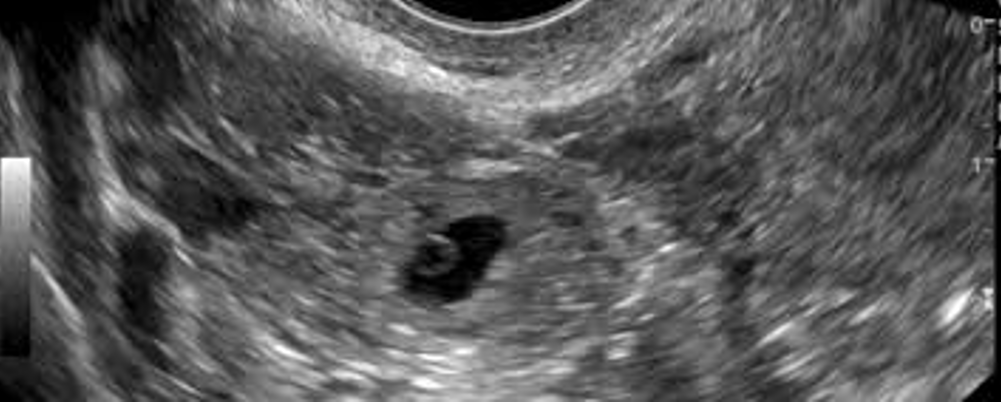
Once the baby is located and the fetal heartbeat is confirmed, the direction of the scan turns to allow the mother to witness the life growing inside of her. As imagers, we are on Holy Ground as we are literally watching the baby being knitted in its mother’s womb right before our eyes. Let us take time to revel in the wonder with her as we are able to show her the baby’s features, including the beating heart. This is the most important time of the scan as the mother is able to see her baby for the first time. The baby’s feet and hands, along with the profile, are impactful images for her and her support system to see. These are perhaps the required images in imaging life.
After the mother has seen her baby and the baby’s features have been shown, it is important to document the required information regarding the exam.
If apregnancy is visualized, the following images should be documented. A transvaginal exam may be performed if information is not obtainable transabdominally.
- A longitudinal or transverse image documenting the location of the gestational sac within the endometrial cavity within the uterus.
- An m-mode image documenting the baby’s heart rate.
- A gestational measurement. (Mean Sac Diameter, Crown-Rump Length or Femur Length)
- A copy of the worksheet or report from the machine with the EDD and Gestational Age.

If, while completing the systematic survey, an area of concern is visualized, documentation of that area should also be included as directed by each specific PHMC Policy and Procedure per the Medical Director.
If an ectopic pregnancy is visualized, the following images should be documented.
- A longitudinal or transverse image documenting an empty endometrium and (if present) a pseudosac.
- A longitudinal or transverse image documenting the location of the ectopic pregnancy.
- Yolk sac (if present)
- An m-mode image documenting the baby’s heart rate. (if present)
- A gestational measurement, if available, or image of an adnexal mass. (Mean Sac Diameter or Crown-Rump Length)
- A longitudinal or transverse image documenting any presence of free fluid.
- A copy of the worksheet or report from the machine with the Gestational Age.
Policies and procedures should indicate the images required for the Limited Obstetrical Ultrasound Exam. They may vary greatly from each PHMC's Medical Director based on their personal preference. For some PHMCs, the preference may be dependent on the type of permanent image created.
As an imager, it is to be noted that whether the image is documented as a permanent image or not does lessen the responsibility of the imager to duly image systematically for each scan. The beauty of ultrasound is its dynamic ability to image life by creating literal images as the transducer is being angled, leaving the responsibility of imaging thoroughly with the imager. Therefore, each image created is to be evaluated.
Imaging Life is such a gift, a privilege, and a responsibility. However, it is imperative that we remember the purpose behind the exams within pregnancy help. The purpose, the why, is to give her the information she needs at that moment in time to make the decision she needs to make. That information is extremely limited when compared to the complete and more in-depth ultrasound studies that the baby will receive during prenatal care if its mother chooses life.
Let us not get too caught up in the technicalities of trying to perform a complete study that hasn’t been ordered, while sacrificing precious time that could be spent imaging the baby for the mother to see.
It truly is so much more than just a scan.
Why the Policies You Want Aren't the Ones You Need
by Valerie Harkins, Executive Director of the Maternity Housing Coalition
There is a very human impulse that shows up again and again in maternity housing leadership:
“Can I see your policies and procedures?”
“Does anyone have a full set I can use?”
“We just need something to get us started.”
This desire is understandable. Housing ministry is weighty work. Leaders are carrying legal responsibility, pastoral responsibility, donor trust, staff wellbeing, and the lives of mothers and children—all at once. Wanting a pre-written roadmap is not laziness; it’s fatigue mixed with responsibility.
But here’s the quiet truth we rarely say out loud: what feels like a shortcut at the beginning often becomes a long detour for years to come.
Why Housing Is Different
In many ministries, templated policies can be a reasonable starting point. Pregnancy centers, for example, often share core operational similarities: appointment-based services, limited client duration, standardized service models.
Housing is different.
Housing is incarnational. I’ve been pondering this word lately. The housing ministry is embodied, relational, and constant. You are not serving a client for an hour—you are stewarding a home, a community, and a shared daily life. The mission is lived out at 2:00 a.m., at the dinner table, in conflict, in relapse, in reconciliation.
Because of that, policies and procedures are not neutral documents. They are theological, sociological, and practical statements about what you believe human dignity requires in your context.
A policy that makes sense for:
- A home serving college students
- A home serving women exiting street homelessness
- A home serving women from a reservation community
- A home serving women in addiction recovery
may share vocabulary—but they should not share substance.
If they do, something important has been skipped.
The Temptation to “Model After” Another Program
It’s tempting to build a program by modeling it after a respected home:
“They’re established.”
“They’re doing it well.”
“We’ll adjust later.”
But program design doesn’t begin with policies. It begins with discernment. When that step is bypassed, policies quietly become misaligned with mission—and the misalignment doesn’t stay contained. It seeps into staff culture, resident expectations, board confusion, and eventually, outcomes.
Policies written before clarity do not save time. They simply postpone the work until it is harder to undo.
What Policies Are Actually Meant to Do
Healthy policies are not aspirational documents. They are protective agreements that flow from three anchors:
- Your Mission
Not a generic mission. Your mission—clearly articulated, bounded, and honest about what you are and are not called to do. - Your Community Needs Assessment
Who are you serving in reality, not on paper? What histories, risks, strengths, and patterns show up consistently in your home? - Your Indicators of Success
Three to five measurable outcomes that, if achieved, mean your mission is being fulfilled at a baseline level.
Only after those anchors are in place do policies make sense. And once policies are clear, procedures naturally follow. Procedures exist to serve policies—not the other way around.
On Measuring Outcomes (Yes, You Can)
Many leaders quietly resist outcome measurement—not because they don’t value excellence, but because goals feel ambiguous or overwhelming. That hesitation is usually a signal, not a failure.
It typically means one of two things:
- The mission statement needs refinement, or
- The organization needs support in learning how to measure what already matters.
There are very few—if any—outcomes in the housing ministry that cannot be measured in some meaningful way. Measurement is not about control; it’s about unity and integrity. It aligns boards and staff, honors constituents, strengthens donor trust, and—perhaps most importantly—guards against mission drift.
What you do not define, something else will define for you.
Learning From One Another—The Right Way
None of this means we stop learning from one another. On the contrary, learning is essential. But how we learn matters.
The strongest growth happens through:
- conversation, not document dumps
- context, not copy-paste
- relationships, not repositories
Networking allows leaders to explain why a policy exists, who it serves, and where it struggles. It allows differences to be respected rather than erased. It strengthens the field without flattening it.
When policies are shared relationally—through story, dialogue, and discernment—everyone grows wiser without compromising their own mission.
A Gentle Invitation Forward
If you feel the pull toward ready-made policies, pause—not to shame yourself, but to listen. That pull often signals a deeper need: clarity, confidence, or companionship in leadership.
Mission leads.
Data clarifies.
Outcomes focus.
Policies protect.
Procedures serve.
That order matters—today and ten years from now.
The companion handout, "Indicators of Success," will help you think through this process. And as always, you are not meant to do this work alone. The strength of this Coalition has never been uniformity—it has been faithfulness, thoughtfully lived out in very different homes, for very different women, with the same deep commitment to life and dignity.
Navigating a Spiritual Winter Season with Discernment
by Lauri Campbell, LAS, Affiliation Coordinator
Sometimes we forget that the God who ordered the seasons of the earth also orders the seasons of our lives. Similar to the natural seasons of our world, there are four spiritual seasons of winter, spring, summer, and fall.
Since it’s February and most of us are experiencing some kind of winter in the natural world, let’s take some time to examine the purpose God has for a spiritual winter. You could be walking in this season now or may experience one later.
Farmers know that winter is not the time to plant, but it is the time to begin preparing to plant for the spring. If God has you in a season of winter, trying to produce something new may prove frustrating.
During a spiritual winter, you may experience darkness and unfruitfulness. You can feel like hopes, plans, and dreams are dying. It can seem that everyone else is flourishing, qualified, and just better than you.
It’s uncomfortable, even painful, and you long for spring.
Galatians 6:9 says, “And let us not be weary in well doing: for in due season we shall reap, if we faint not.”
Child of God, you must persevere through a spiritual winter to reap what God has in store for you in a spiritual spring. We can’t skip this season anymore than we can skip December through February.
At times, hibernation sounds really good for this season, but you’re not a grizzly bear! You’re a child of the Most High God, and He’s doing something in and through you. He’s faithful to complete what He started, remember? (Philippians 1:6)
It’s not a matter of if, but when. Spring is coming! Don’t grow weary. Don’t sit this season out.
Use this precious time to press into God. This spiritual winter season is appointed—Divine. It’s ordered by your Creator. It’s part of the plan, not a diversion from the plan. Don’t let the enemy tempt you to believe that you’ll be left here in winter or that you’re walking alone.
There is a time for everything,
and a season for every activity under the heavens:
a time to be born and a time to die,
a time to plant and a time to uproot,
a time to kill and a time to heal,
a time to tear down and a time to build… Ecclesiastes 3:1-3
We don’t like some of these words: die, uproot, kill, tear down. But they’re Scriptural words. Holy words. Words of sanctification. God often uses spiritual winters to get us to, well…die to self. (Galatians 2:20)
The Holy Spirit may be prompting you to uproot some strongholds in your life. (2 Corinthians 10:4-5)
Is there an area of unforgiveness, bitterness, or disobedience that needs to be killed so you can heal? (Romans 6:6)
Do you have idols you need to tear down so God can build something holy and authentic into your character? (Micah 5:13)
God calls us to “throw off everything that hinders and the sin that so easily entangles (Hebrews 12:1-3). Killing off such things allows Him to cultivate holiness and joy in us, dismantle the shame we carry, and truly rest in His presence. We gain strength and stamina for what lies ahead. Learn to embrace the spiritual winter season because God is developing your root system. Don’t reject this time of deep growth that’s beneath the surface but so vital to the fruit He longs to produce in you. Learn what God is teaching so you can move to the next spiritual season.
How you respond to the Lord in this season will determine what you produce in the spring. Be patient, then, brothers and sisters, until the Lord’s coming. See how the farmer waits for the land to yield its valuable crop, patiently waiting for the autumn and spring rains. (James 5:7)
Choosing Love That Stays
by Michele Cheresnick, LAS, Affiliation Coordinator
Some seasons invite celebration. Others invite presence. Some days call for grand gestures; other days call for quiet listening, for staying, for just being with someone as they carry what is hard to name. In those quiet moments, love, care, and safety quietly take shape.
In a world that often rushes past pain, choosing to stay and offer a safe place for truth may be one of the most meaningful valentines we can give. Speaking openly about abortion can feel risky. Many women carry questions, regret, shame, or unresolved grief quietly, unsure whether it is safe to speak—or whether their story will be met with care.
What I’ve learned is this: safety isn’t created by having the right words. It’s created by being willing to stay when the words finally come.
In our centers, we can feel pressure to know exactly what to say, especially when abortion enters the conversation. We want to be helpful, gentle, and wise. We don’t want to cause harm. But whether a woman is still considering abortion or carrying a past abortion story, whether she’s a client or a coworker—she is often listening for something simpler:
Is this a place where I can tell the truth and still be welcome?
Truth after an abortion rarely comes all at once. It comes in fragments, in pauses, half-finished sentences, sometimes years later. Many women who have experienced abortion learned early that silence felt safer than honesty, especially if they sensed their story might make others uncomfortable.
Staying—emotionally, relationally, and compassionately is what makes room for the truth to breathe.
This matters not only for the women we serve, but also for those of us who are doing the serving. Some pregnancy help workers and volunteers have experienced abortion and stepped into this work hoping to give what we ourselves never received. And while that desire often comes from a place of deep compassion, it doesn’t erase our own need for care.
Self-love here isn’t indulgence or self-centered. It’s honest. Caring for others doesn’t disqualify us from needing care ourselves. In fact, our own healing deepens our ability to stay present when another woman finds the words she’s been holding back.
This posture of staying becomes especially important when we think about all the women who don’t come back. Many who have abortions after visiting a pregnancy help organization never return. Not because the center failed them, but because shame, grief, or fear quietly convinces them the door has closed. They may assume everything will now be awkward or heavy or focused solely on the abortion. So they disappear, often believing they must carry their pain alone.
Reaching out to someone who has had an abortion can feel intimidating. We worry about saying the wrong thing. But reaching out isn’t about getting her to come back; it’s about letting her know she was never forgotten.
Sometimes love looks like a single message sent with no expectation of response. A gentle check-in that says, “You still matter.” No explanation. No lesson. Just presence, offered from a distance.
Simple words are often enough:
- “I’ve been thinking about you and wanted you to know you’re not forgotten.”
- “I don’t need anything from you—I just wanted to check in.”
- “Whatever you’re feeling right now, you don’t have to carry it alone.”
Naming safety matters too:
- “If you ever want to talk, now or later, this is a safe place.”
- “You don’t have to have the right words here.”
- “There’s no pressure and no timeline.”
For women who may never return, it can be powerful to say, “You’re welcome here whenever you're ready.”
Staying doesn’t always look like ongoing contact. Sometimes it looks like trusting that the kindness offered once still matters.
This Valentine’s Day, love may not look like hearts or flowers. It may look like restraint. The choice not to rush, not to fix, not to fill silence with answers. It may look like a calm, steady presence, an open door, or a message that asks nothing in return.
Because safety isn’t created by having the right words. It’s created by being willing to stay when the words finally come.
More Than a Milestone: What 2 Million Connections Reveal About Being There for Women
by Andrea Trudden, Vice President of Communications and Marketing
Last year, Option Line surpassed 2 million connections with men and women facing pregnancy decisions. That is five times the number of connections from the year before and the highest annual total in the program’s history.
It is an incredible milestone worth celebrating.
But the real story is not the number. The real story is what the number represents: women reaching out for help at all hours of the day and night… and finding someone there.
Roughly 40 percent of those 2 million connections happen outside typical business hours, where we could just hand them off immediately to local pregnancy help.
They happened late at night, early in the morning, on weekends, on holidays, and in moments of panic, pressure, and urgency. These are the hours when most brick-and-mortar pregnancy help organizations are closed. And these are often the exact moments when a woman is searching online, looking for answers, and deciding what to do next.
Option Line exists for this reason.
We ensure that when a woman searches for help at 1:00 a.m., she does not find silence. She can find a calm voice, accurate information, and a direct path to real, local support.
When she wants to talk to someone directly, we answer the call. If she wants to find her own information, our center locator guides her to the services she needs and, when possible, allows her to schedule an appointment with her local pregnancy help organization.
Option Line is intentionally built to work with the pregnancy help movement, not around it.
Almost all of these connections result in a referral to, or an appointment with, the local pregnancy help organization for the services you offer in her town.
For many women, the first compassionate conversation they have happens with Option Line in the middle of the night. The next step in that journey is walking through the doors of a pregnancy help center.
In this way, Option Line becomes an extension of your organization after hours. We give pregnancy help centers a 24/7 presence even when the lights are off and the doors are closed.
Behind every connection is a woman who is actively looking for help in real time.
She may be facing pressure from a partner. She may be scared and alone in a dorm room. She may be a mother unsure how she will care for another child.
What she needs in that moment is not a voicemail. She needs a person.
Option Line consultants and Option Line Plus nurses provide a listening ear, health education, and clear next steps, often guiding women toward local pregnancy help organizations where they can receive hands-on care.
Fear turns into clarity. Isolation turns into connection. A late-night search turns into an in-person appointment.
Why This Matters for the Movement
This record year is evidence of two things happening at the same time:
- The need for pregnancy help is increasing.
- Women are actively looking for life-affirming support at all hours.
And because Option Line exists, they are finding the help they need.
This is a story pregnancy help organizations can share with supporters. It shows that pregnancy help is not limited to a building with only office hours. It is a coordinated, always-available network of care ready whenever a woman reaches out.
As this need continues to grow, many pregnancy help organizations are beginning to think more intentionally about how they can be present for women beyond their open hours.
More affiliates are exploring ways to offer after-hours telecare or dedicated hotlines so that when a woman connects with Option Line overnight, there is an even more seamless bridge into their local support, expediting speed to service.
It is a natural next step in strengthening continuity of care and ensuring that no woman ever feels like she has to wait for help.
Reaching 2 million connections is a powerful achievement. But what matters most is this: At every hour of the day and night, women are reaching out. And together, the pregnancy help movement is there to answer.
That is something worth celebrating.