Heartbeat International Launches National Tracker Documenting Reported Abortion Pill Poisonings and Forced Abortions

New public resource seeks to track growing reports of coercion, deception, and abortion drug misuse across the United States

May 29, 2026

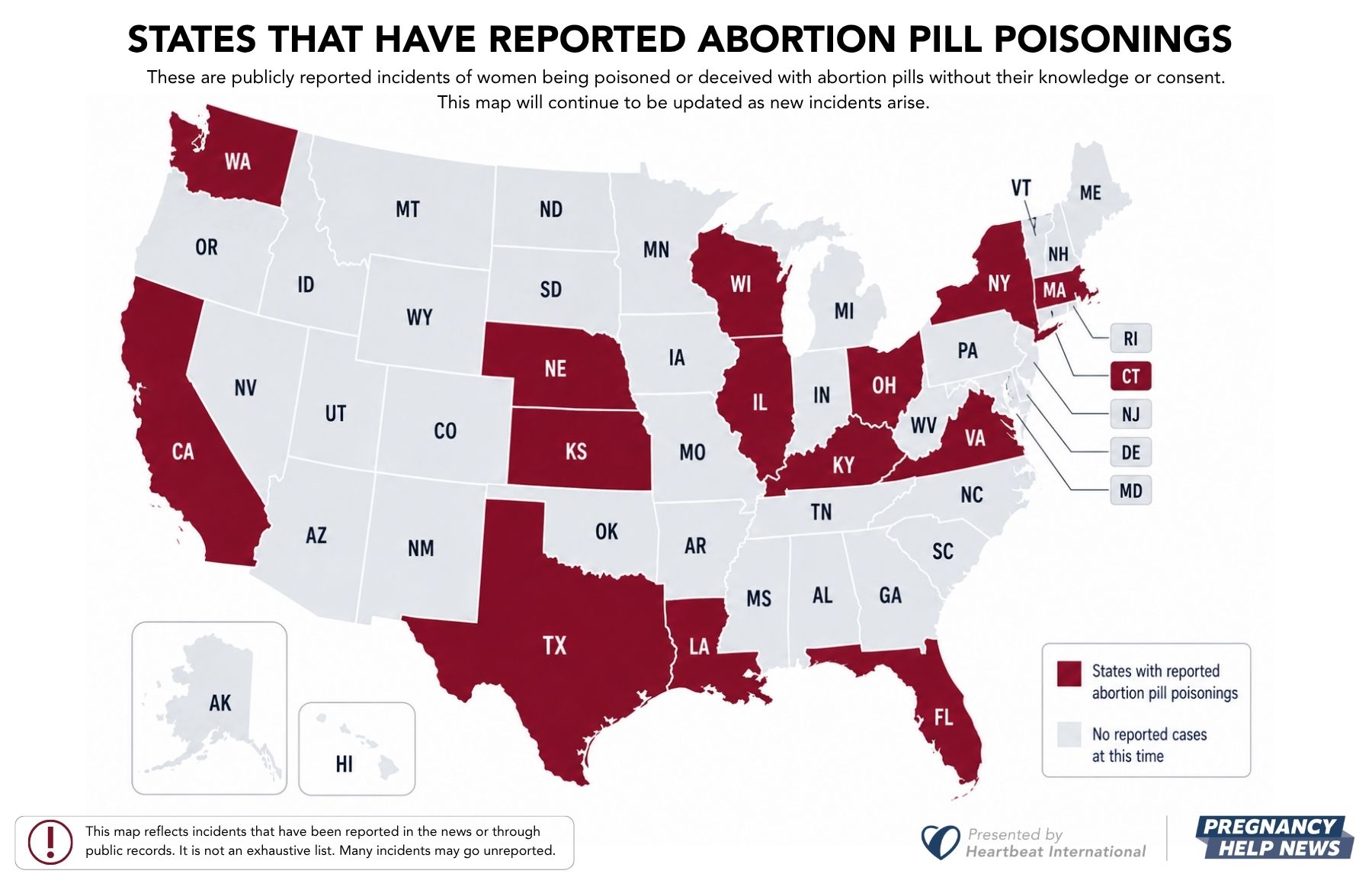
States that have reported abortion pill poisoning 4COLUMBUS, Ohio — Heartbeat International launched a new national tracker documenting reported abortion pill poisonings and forced abortions across the United States. The tracker, hosted by Pregnancy Help News, provides a centralized resource for journalists, policymakers, pregnancy help organizations, and members of the public seeking to better understand the growing number of reported incidents involving abortion drugs being used without a woman's knowledge or consent.

The tracker compiles publicly reported cases from across the country and organizes them by state. Heartbeat International plans to update the resource as additional incidents become known.

The project was developed in response to an increasing number of calls received through Heartbeat International's Abortion Pill Rescue® Network (APRN), which provides care to women who regret beginning a chemical abortion and seek information about continuing their pregnancies. In recent years, APRN staff have also observed a troubling increase in calls involving reproductive coercion, pressure to abort, and allegations that abortion drugs were administered without a woman's knowledge.

"We are hearing from more women who feel pressured into abortions they do not want, many coerced or forced abortions, and we are increasingly hearing from women who believe they are being poisoned with abortion drugs," said Christa Brown, Senior Director of Medical Impact for Heartbeat International who oversees the Abortion Pill Rescue Network. "Many of these women are frightened, confused, and unsure where to turn. They often are afraid that no one will believe them."

According to Brown, the concerns extend beyond individual cases and point to a broader pattern emerging alongside the widespread availability of abortion drugs through mail-order distribution and online providers.

"Every woman deserves to make decisions about her pregnancy free from coercion, threats, manipulation, violence, or deception," Brown said. "When abortion drugs become increasingly accessible outside traditional medical settings, opportunities for misuse also increase. The stories we hear every week remind us that these drugs can be used not only for abortion but, in some cases, as tools of control and abuse."

While Heartbeat International has maintained internal records of reported incidents for years, organizational leaders determined that a public-facing resource was needed to help identify trends and provide greater visibility into a growing concern.

"Publicly reported cases likely represent only a fraction of what is actually occurring," said Andrea Trudden, Vice President of Communications and Marketing for Heartbeat International. "Many women never report what happened to them, particularly when the person responsible is someone they know and trust. By creating this tracker, we hope to provide a factual resource that helps illuminate patterns that might otherwise go unnoticed."

Heartbeat International hopes the tracker will serve as a reference point for media coverage, policy discussions, research, and public awareness efforts related to abortion pill distribution and safety.

The tracker is available now through Heartbeat's news website, Pregnancy Help News, and will continue to be updated as new reports emerge.

About Heartbeat International
Heartbeat International is the world's largest network of life-affirming pregnancy help organizations, supporting more than 4,000 affiliated locations in more than 100 countries. Through programs including Option Line® and the Abortion Pill Rescue Network®, Heartbeat International connects women facing unexpected pregnancies with compassionate support, medical referrals, and life-affirming care.

Professional Growth and Support

 The following excerpt is taken from Governing Essentials. To learn more about this valuable resource, click here.

The Board is responsible for setting an atmosphere in which the Board itself and the Executive Director have what they need to do their jobs in the best possible way. This means (1) a good working environment, including space and equipment; (2) a good salary and benefits for the Executive Director (and staff), and (3) budget support and encouragement for continuing education and training for the Executive Director (and staff).

For new organizations, and those that have been “getting by” with very small budgets for a long period of time, this may sound impossible. However, it is the Board’s moral responsibility to see that those under their care, especially the Executive Director, are treated with dignity and respect, and that their gifts are developed. If the Board models this with the Executive Director, that treatment will hopefully be modeled with the rest of the staff and with volunteers. When this happens, you will see the fruits – in the “blossoming” of staff and the greater growth and effectiveness of the organization.

AdobeStock 403783557Stepping out in faith may be the way that a new or small organization moves from small salary and benefits to providing a better compensation package for the Executive Director. A committed donor might be convinced to fund a “capacity-building” plan that allows the organization to upgrade office space and equipment and raise the salary of the Executive Director. As with all growth, what is needed is turning it over to the Lord, taking one small step forward, and following with one more step at a time as the Lord blesses.
 
Growth opportunities can be provided in many ways: mentoring of the Executive Director by an executive on the Board or perhaps a donor, community workshops provided by local foundations or United Way, a line item in the annual budget to send the Executive Director and key staff (plus two or more Board members!) to a major Heartbeat International training event (International Conference, Executive Roundtable, or Leadership Institute). Some of the Annual Conference training is available in a format that can be accessed by a group of staff members on-site at your organization. Training courses are also available through Heartbeat Academy.

A commitment to on-site training of Board and/or staff every few years is a tremendous way to nurture your center. Heartbeat International Consultants can come to you! Strategic Planning, organizational assessment, LOVE ApproachTM, and other opportunities are provided by Heartbeat International on site.

A prayer retreat for Board and Executive Director (and perhaps include other staff leaders) is a blessing that can be provided by a local pastor or priest (or both!). Use your creativity to provide a variety of training and support opportunities for your leadership team and for your staff.

Local training events also provide an excellent networking opportunity for Board members and Executive Director (and staff) with other nonprofits in the local community and, in the case of Heartbeat International events, with similar ministries all over the world.

The new relationships, plus renewed enthusiasm and the spiritual renewal that result from such events, make these very wise investments in your organizational growth and Mission. 

Nurturing is key to fulfilling your Mission and working toward your Vision for a culture of Life in your own community. It is also a major responsibility of your Board to feed this ministry of the Lord.
 
Board Activity
At a Board meeting, discuss how your organization is doing at present with professional development and support for your own leadership team (Board and Executive Director) and for the rest of your staff. What do you have currently in place? Do all of you have the training and support to grow and develop more knowledge and skills, and become even better laborers in the vineyard of the Lord? If more attention is due to this aspect of Nurturing, how will you move forward? (Who does what, and when?)


Mid-Year Check-In: Are You Ready for Your Year-End Story?

by Andrea Trudden, Vice President of Communications & Marketing

It's hard to believe we're already halfway through the year.

For many Pregnancy Help Organizations, January feels like it was yesterday. Yet before we know it, fall events, year-end appeals, annual reports, and budgeting conversations will be upon us. The organizations that navigate those conversations with confidence are rarely the ones scrambling in November to gather numbers, locate photos, or remember client stories. These are the organizations that have intentionally collected and reviewed key information throughout the year.

In the past, we shared an article on crafting a comprehensive and impactful annual report. While annual reports may feel far away, the middle of the year is actually the perfect time to evaluate whether you're gathering the information you'll need to tell your story well when December arrives.

Consider this your mid-year leadership check-in.

Are You Tracking the Right Numbers?

Take a few moments to review your goals and reporting systems.

Do you know:

  • How many clients have you served so far this year?
  • How do your service numbers compare to the same time last year?
  • What mid-year insights are you seeing in the analytics?
  • Which programs are growing?
  • Which services may need additional attention or promotion?
  • Are your fundraising goals on pace?

Many organizations discover late in the year that they wish they had been tracking a particular metric more consistently. A mid-year review gives you the opportunity to make adjustments now while there is still time to gather meaningful data.

Supporters, just as much as board members, are increasingly interested in measurable outcomes. They want to connect the number of people served with how lives were impacted through those services.

AdobeStock 555068302Are You Capturing Stories Along the Way?

One of the most common challenges organizations face when preparing year-end communications is finding compelling client stories.

The reality is that powerful stories rarely appear on demand.

Now is the time to ask your team:

  • Have we documented top-level client success stories?
  • Do we have proper permissions where needed?
  • Have we collected related photos, quotes, or testimonials?
  • Are there families, volunteers, or donors whose stories illustrate our mission?

The stories that resonate most deeply at year-end are often the ones that have been carefully gathered throughout the year. Every pregnancy test, parenting class, ultrasound appointment, and material assistance visit represents a person whose life may help demonstrate your organization's impact.

Pro Tip: Make storytelling a regular part of your internal team/staff meetings. Encourage sharing recent client interactions and moments of impact. This helps create a culture that values storytelling and helps staff identify stories worth documenting before they're forgotten. Over time, you'll build a library of authentic stories that can be used in donor communications, annual reports, fundraising appeals, and community outreach. The organizations that consistently capture stories throughout the year are often the most effective at demonstrating impact and inspiring support. Always have a release form if you use the client’s name or use an alias.

How Are Your Fundraising Goals Progressing?

Mid-year is also an ideal time to evaluate fundraising performance.

Review your annual budget and compare current giving against projections. Ask questions such as:

  • Are we on pace to meet our fundraising goals?
  • Have donor retention rates remained strong?
  • Are there major donors who need personal follow-up?
  • Do we have a plan for our fall and year-end appeals?
  • Are there opportunities to strengthen donor stewardship now?

Year-end giving often determines whether organizations meet their annual goals, but successful year-end campaigns are rarely created in December. They are built through consistent communication and relationship-building throughout the year.

Does The Board Have the Information They Need to Communicate Your Mission Well?

Board members play a critical role in advancing your mission, but they can only champion your work if they understand it and can communicate it to others.

Take time to evaluate the information being shared with your board. Along with financials and canned reports, are you regularly providing:

  • Missional program updates?
  • Meaningful impact data?
  • Shareable client stories?
  • Strategic progress updates?

A well-informed board is better equipped to advocate, fundraise, and provide governance for the organization.

Looking Ahead Starts Today

The strongest annual reports, fundraising appeals, and donor conversations don't begin at year-end. They begin with intentional preparation throughout the year.

As you move into the second half of the year, consider scheduling a leadership review with your staff and include the findings for discussion at a board meeting. Revisit your goals. Evaluate your data collection processes. Gather stories. Review fundraising progress. Celebrate wins. Identify challenges.

Most importantly, make sure you're documenting the evidence of the life-changing work happening every day through your organization. When year-end arrives, you'll be grateful you took the time to prepare now rather than trying to piece together your story after the fact.

Your mission deserves to be told well. The best time to start preparing for that story is today.

For a full list of year-end resources, click here.


It’s the Board’s Responsibility to Nurture the Team

by Lauri Campbell

At Heartbeat International we believe strongly that one of the six major responsibilities for the Board of Directors is to Nurture the people of the organization.  

Boards Nurture their teams in two ways. First, by creating a culture of servant leadership. It’s especially important that they model servant leadership within the leadership team: with fellow Board members and the Executive Director. 

Second, by providing professional growth opportunities and support for themselves, the Executive Director and staff.

In John we see Jesus teaching the disciples how they can demonstrate their love for Him.

AdobeStock 340497512“‘Do you love Me?’ And he (Peter) said to Him, ‘Lord, You know all things; You know that I love you,’ Jesus said to him, ‘Feed My sheep’” (John 21:17b).

In Heartbeat’s Governing Essentials manual, Peggy Hartshorn writes, “The Board’s authority over the organization, its role of stewardship, comes from the Lord. The Board “feeds” the organization, like Jesus instructed His disciples to feed those He put under their care. Jesus made them shepherds over His sheep.”

The Board is responsible to see that the organization has what it needs to develop in a healthy way. This is the calling of God on Christian Boards—steward and shepherd the team as unto the Lord.

As a board member for many years I understood the first part of my Nurture responsibility almost instinctively. I knew how important it was to create a culture of servant leadership and to interact with my fellow board members and the Executive Director from a place of humility and service. That’s what Jesus modeled and I had seen this lived out in my home and in church life.

Unfortunately, my understanding of our responsibility to Nurture the team did not extend to include professional development.

I saw it as a luxury we could not afford.  

Boy was I wrong! Turns out it's really quite the opposite. Development is an investment we cannot afford to overlook!

When I later became the Executive Director myself it took me a couple of years but I finally learned the value of investing in continuing education and training for the Board, myself and the staff.

When our Board received Heartbeat’s Governing Essentials training and later engaged a Heartbeat Strategic Planning expert our growth and strength as an organization and team grew. We could see the fruit of those professional development investments. Giving increased, the budget got larger, client visits increased, our number of staff positions grew and our mission of reaching the abortion minded gained some much needed focusing.

The investment of training and development pays off immeasurably. When people are encouraged in their work, strengths and gifts to do their best, they naturally work harder to do a good job and we saw this play out in our ministry.

Investing in professional development tells people that you care and you want to see them excel at their jobs. Conversely, neglecting their training and development often leaves people feeling unappreciated, aimless and discouraged.

Servant leadership means putting people first and one of the ways a healthy board can do that is to provide opportunities for people to develop and optimize their God-given gifts. 

In the Parable of the Talents (Matthew 25:14-30) Jesus warns against laziness. The servants who invested and grew their talents were rewarded, while the one who buried his talent was rebuked. 

Boards should position people for success by asking them to do and build on what they do best. As we invest in the gifts of our teams, we can expect to watch their confidence grow. Capitalizing on the strengths each team member has been blessed with will increase effectiveness and confidence individually and organizationally.

As servant leaders we must not expect healthy organizations without providing leadership development.

You can run an organization without investing in your team's development, but eventually some or all will experience burnout and the mission will suffer.You may have saved money and time but the cost you end up paying is much greater than any budget line item can reflect.

It all comes back to stewardship.

As a Board of Directors you’ve been given a team of people to steward by God. 

At your next Board Meeting I challenge you to ask your Executive Director and fellow board members these questions:

  • How are we doing with professional development and support for our own leadership team (Board, Executive Director) and for the rest of our staff?
  • Does everyone have the training and support to grow and develop more knowledge and skills and become even better laborers in the vineyard of the Lord?
  • If more attention is due to this aspect of Nurturing, how will you move forward to rectify what’s missing?
  • What specific steps will you take to Nuture your team through professional development?

Heartbeat has training and professional development for everyone from Board members to client advocates, Executive Directors, nurses and everyone in between. It’s affordable, Christ-centered and designed specifically for pregnancy help organizations (PHO). It’s taught, written or facilitated by people who have been in PHOs for years, often decades. So please take advantage of the resources and training we offer.  It’s our honor to help you steward your team’s development.

Click here for practical ways you can nurture your team today. 

Is Today’s Client Tomorrow’s Donor?

by Liliana Grace

Communication is about what you say, how you say it, and how it is received.

Have you ever been misunderstood?  In every conversation, there are often multiple conversations happening.  One is the one you think you are having; the other is the one that is being received. 

AdobeStock 304537224One of the most common questions I get asked is, “How can my marketing speak to both clients and donors simultaneously?”

My response is that there will be times to have unique messages, but the most impactful brands have a core message that spans both audiences. 

When you promote the impact you are having in your community, the services you provide, and the outcomes, that will attract both clients and donors.   

Do hear me: there will be times in which you might take a deeper angle of a unique perspective specific to the donor or the client. However,  when it comes to branding and paid marketing, look to have consistent messages sharing what you offer, who you serve, and how you serve.

Have a clean message that is clear, concise, and consistent. 

Consider for a minute if your next unreached donor opportunity were the age of your clients?  In both client and donor messaging, the core of what you offer, and the heart in how you offer it, should be consistently presented. 

In donor marketing, we often gravitate towards a traditional legacy style donor looking for that next big gift.  Consequently, the natural thought is to use a very traditional approach.  I agree that much of this will work, but for this article, let’s think about going beyond that and think about how marketing can engage both potential clients as well as a younger donor.

If we get it down to basics, all donors are looking for someone they can trust with their money, as well as feel good about helping with a cause they believe in.

Younger donors often approach their giving as more “in the moment”.  

When something moves them, they act.  They ask, “Is this organization providing a solution to a problem that I think is problem?” or “Do I know/trust this organization and the person asking for the money?” 

The trust they are looking for can be transferred based on showing the successful outcomes, through a recommendation of another trusted source, or even a quality social media page that is consistently updated with relevant empowering messaging of the mission and brand.

Younger potential donor groups have grown up with digital currency and concepts like, crowdfunding, peer-to-peer funding, and micro gifts.  This donor group seeks community, something in which to believe, a cause that matters and, once discovered, will support it and tell others to do the same.  An ask can go “viral” and then the real magic can happen.

How can you catch this “lightning in a bottle?" You need a lightning rod.  Create and maintain a clear, concise, and consistent message through all aspects of your marketing and outreach.  Be sure your social media is on brand and empowering. Be seen and be relevant.

As you approach your client marketing, keep in mind, they just might be your next donor.  Build your brand. Design your messaging to showcase the impactful services you provide and the hope you offer while simultaneously showcasing the opportunity that everyone can be a part of the solution.

Always remember, today’s client can be tomorrow’s donor.                   

To your continued success in empowering women,

Screenshot 2026 04 27 135555

Liliana Grace
Founder, L Grace Brands
This email address is being protected from spambots. You need JavaScript enabled to view it.


How to Eat with Your Donors

by Bryan Gonzalez 

In my 15+ years of fundraising experience, sitting down with a donor for coffee, tea, hot chocolate, breakfast, or lunch is almost always the most effective fundraising strategy.  But why?  Well, with whom do you usually “break bread”?  With friends and family.  And, if you’ve been following this column for any length of time, then you’ll know how important “donor centric fundraising” is because it’s here that we focus on relationships.

Quick caveat:  tours of your PHO are also really effective, but this article will focus on offsite donor meetings. 

Once you’ve made the appointment with a donor (and if you need help getting donors to respond, this article can help with that), what might be some tips on how to eat with your donors?

AdobeStock 513098549First, make sure that the objective is clear with the donor ahead of time.  Is this an appreciation meeting?  Is it a getting-to-know-you meeting?  Is it a solicitation?  In your pre-meeting communication, be sure to make this clear, so it’s not a surprise to the donor.  What if you say it’s an “appreciation” meeting, and the donor – at the end of the meeting – says: “Well, what you’ve said is really impressive… would you like to ask for a donation?”  Exercise respect with your donors and say, “Well, that’s not what we came here for; I’d rather not change the point of the meeting.”  Feel free to follow up in an email or phone call, though, and make an ask, but – in general – it’s not good to change the point of the meeting mid-meeting.

Next, put your devices away!  A sure-fire way of demonstrating that your donor doesn’t really matter is to leave your phone on the table.  There may be a need to show your donor a photo of your family, or grab a video from your website, or open your iPad for some graphs/charts; however, put them in a bag, purse, or on the chair beside you.  Smart watches are also really distracting, so if there’s a way to silence them for the meeting, then do it. 

Caveat:  if your donor’s phone goes off, or if their smart watch rings, tell them: “Oh, feel free to answer that!”, as it shows respect for their time.  It’s possible that they need to tend to something, and we can patiently wait.

Thirdly, let’s talk about the food itself.  In general, avoid messy or distracting foods.  Spaghetti, giant burgers, saucy wings, overloaded tacos, or anything that requires constant wiping, slurping, or fighting with utensils can become a distraction.  You want the donor focused on the conversation – not wondering whether sauce is about to land on your shirt.

Likewise, avoid strong-smelling foods when possible.  Fish, excessive garlic, onions, or heavily spiced dishes may linger throughout the meeting.  The same goes for ordering alcohol, unless you already know the donor well and understand their comfort level.  When in doubt, keep it simple and conservative.

Also, don’t order the most expensive item on the menu.  Even if the donor insists on paying, humility matters.  A simple sandwich, salad, soup, or breakfast plate keeps the focus where it belongs – on the relationship.  If you are paying with ministry funds, modesty demonstrates good stewardship.

Try not to overeat.  This sounds obvious, but many fundraising lunches unintentionally turn into personal mealtime.  Take smaller bites and pace yourself.  On the one hand, a donor meeting is not the moment to clean your plate in record time or spend long stretches chewing while the conversation stalls.  On the other hand, if you’re going to make an ask or invite a donor to make a gift, then you’ll want to finish your meal in enough time to discuss the particulars about the project and spread out information on the table (be sure to clean it beforehand!), and discuss things.  To summarize: pace yourself and watch how quickly the donor is eating, so that you finish up about the same time, and can accomplish the objective of the meeting (see point #1).

One surprisingly important detail: be kind to restaurant staff.  Donors notice how you treat waiters, hostesses, and cashiers.  Courtesy, patience, and gratitude reveal character.  In many ways, your interaction with staff may communicate more about your ministry than your fundraising presentation.

Finally, be mindful of meeting one-on-one with donors of the opposite sex.  Perhaps this seems either obvious or to the other extreme, prudish, but I think (in general) the Pence Rule is a good one.  Meeting in public one-on-one with a donor of the opposite sex is critical then, but it could still give rise to the appearance of scandal.  Maybe even ask the donor if they feel comfortable meeting one-on-one, or if they’d feel more comfortable with a colleague or a board member.  Agree to meet at the coffee shop or restaurant, instead of riding together.  Inform your colleagues at the office that you’re meeting with someone and also share it with your spouse so they know.  The less secretive it is, the better it is for all parties.

It goes without saying that you need to be courteous, ask good questions, know enough about your ministry, don’t chew with your mouth open, don’t gulp when you drink, etc.  But this article is more about some things we may take for granted in 2026 when meeting potential donors for food and drink, even though it’s not really about the food and drink:  it’s about building trust, strengthening relationships, and inviting people deeper into the mission that God has entrusted you with your PHO.  A thoughtful, respectful meal can open the door to years of partnership and impact for life.

Practical Tip:

How often do you go to coffees or lunches with your donors?  If this isn’t a regular part of your fundraising strategy, start by making a list of 5-10 donors you’d like to take for appreciation lunches (those are good places to start) and try that first.

**Do you have topics you’d like me to write about or have comments/feedback on my articles?  Send me an email:  This email address is being protected from spambots. You need JavaScript enabled to view it.**


How to Find Grantmakers

by Haley Limo

Lately, many of my clients have been asking about applying for more grants from foundations. Because this seems to be a hot topic, I thought I would share with you some of the important aspects of finding and securing grants.

First, you need to find grants to apply to. This can be very difficult since 90% of foundations do not have a website. The only way to find them is through their 990’s. Having a subscription to Candid’s Foundation Center is going to be the gold standard in finding different foundations to apply to. While they offer nonprofit pricing, the price is still quite an investment. If possible, I would suggest using their “Candid Near Me” link to see if any local libraries near you carry their software. This is an excellent way to use a free resource to secure more funding

After you get your list of potential grant makers near you, targeting the family foundations is going to be the best segment for you to target. Over half of all grant-making foundations are family foundations. More importantly, they are well-capitalized: over half of these family foundations hold assets exceeding $10 million.

AdobeStock 882815297By law, these organizations are mandated to distribute a minimum 5% payout of their assets annually, though many are even more generous, with 75% paying out more than the required minimum. Despite this capital availability, finding them requires strategy. As stated, only 10% of family foundations maintain a public website. However, every single one of them is required to file a Form 990 with the IRS, which serves as your ultimate transparency tool.



When analyzing data from platforms like the Foundation Directory Online (FDO), your first step should be to transfer the results directly into an Excel spreadsheet. Data organization is critical to preventing administrative overwhelm.

As you audit your list, filter out the "obvious misses." For a targeted foundation strategy, filter out automated or pass-through giving platforms like AmazonSmile, Donor-Advised Funds (DAFs), and broad community foundations. Instead, keep your core focus locked onto dedicated family foundations. Once your list is refined, initiate deep-dive research by Googling the foundation's name alongside the term "990" to pull their official tax filings if you don’t have a Candid login. The best free websites will be Pro-Publica or Instrumentl.

Foundations generally fall into two categories regarding how they accept applications, and each requires a slightly different outreach strategy:

1. Foundations that Accept Unsolicited Grants

For these organizations, your first step should always be to call them directly using the phone number listed in the middle section of their Form 990. Once contact is established, explicitly follow the formal steps they provide to submit a full grant proposal, and ensure you follow up as needed. They will usually have those instructions listed on the 990 or on their website.

2. Foundations that Do Not Accept Unsolicited Grants

Do not let a "no unsolicited proposals" rule completely deter you. Instead, look up their number on the 990, call them first, and pivot your strategy toward submitting a brief, compelling Letter of Interest (LOI) to introduce your work and gauge alignment.

Just because they indicate that they don’t accept unsolicited grants does not mean they aren’t willing to hear you out. Many times, grant makers check that box to ensure they aren’t flooded with email and letter requests, but that doesn’t mean they aren’t open to some new programs.

Some of the largest gifts I have ever received have been from family foundations who said they don't accept unsolicited grant requests!

Crafting the Perfect Pitch

When calling an administrator, clarity and brevity are paramount. Your script should introduce who you are, state your desire to chat about grant opportunities, and deliver a concise, human-centric elevator pitch. For example:

"Hello, I am looking for an administrator with the foundation. My name is Haley with LOT Philanthropy. I would love to chat with someone about applying for a grant. We help abortion-vulnerable women choose life."

If the foundation requests an LOI, structure it formally. State your mission upfront, provide clear historical statistics illustrating your impact since inception, offer a brief overview of your programs, and politely request the next steps to submit a formal proposal. With an organized spreadsheet and a confident outreach strategy, your nonprofit will be well-positioned to unlock vital foundation funding.

That’s it!I hope that these few tools are enough to unlock the next steps on your foundation journey!


My Burden Is Light

My Burden Is Light

Imaging in Pregnancy Help Medical Clinics (PHMCs) places each of us on the front lines regarding abortion. What might have started as an easy "yes" to help a friend, inadvertently placed us within a movement that allows us the privilege to image in Holy Ground. At the same time, God is knitting His creation in its mother's womb, and we intimately understand the reality of life and death. For some babies, we may be the only ones who pray for them and honor them as we scan. Over time, this can be wearing on one's soul.

Several years ago, we received a call from an abortion provider asking if we could scan an early OB exam. Their sonographer was out for the day. We had an open-door policy for them. If they needed an ultrasound done, we would be more than happy to provide the service. This allowed us to not only interact with their client but also be the ones to show her the baby in a calm and less clinical fashion. The history that we were given was that she had an abortion three months ago and that she was pregnant again. She was determined to abort again and was simply looking for verification of the pregnancy so she could schedule the procedure. We added her on the schedule and instructed them to send her right over.

Expectant mother in a quiet, contemplative moment

I remember before I walked into the room to do the exam, I hesitated. I went back into the office with the pregnancy wheel to see how far along the first pregnancy would have been if she had not had the abortion. I'm not sure why I did this, but I felt like I needed to know. Perhaps, it would come up in conversation regarding this pregnancy, I thought. I hesitated again, praying for her and her unborn baby. Prayed that God would give me the words, the love, and that she would see Him through me.

I realize now that He was preparing me for what I was about to see.

As I entered the room, the lights were already turned down. She was accompanied by her mother and there was little dialogue between the two as I prepared to scan. It was so very quiet. I remember placing my transducer down and seeing instantly on the screen not an early baby but one that was easily in the second trimester. She saw as quickly as I did, and responded, "I can't do this." I began to pray as I started scanning her baby, narrating what I was seeing. I started with the baby's face, its hands and its feet. We looked at the baby's beating heart, and I began to hear sobs in the room. See, the baby that we were scanning somehow, someway, wasn't a new pregnancy but was the baby from the pregnancy that had been aborted. Only God.

Only God.

Her mother asked, "How?"

"I don't know," I replied, "but sometimes we are given second chances." As I continued to scan.

Slowly, her mother revealed that she, herself, had an abortion at the same age as her daughter. It was all that she knew to do. It was the only answer she had for her daughter. What a blessing it was to be able to share the many answers for the both of them. Through the services at the PHMC, we were able to help the mother with post-abortion care and walk through her daughter's pregnancy with her. There was freedom found in that room that day.

I still reflect upon that day with wonder. What if we would have said, "No."? What if the sonographer at the abortion provider would have been there that day? So many "what-ifs" and yet, the God Who called us to image the unborn planned each and every detail ever so perfectly. (At that time, I was the only imager confident in scanning past the first trimester. I happened to be at the PHMC that day instead of in the mobile unit.) God's timing was ever so perfect.

In this calling that God has placed upon our lives to image the unborn, we can easily get caught up in the details, fretting over this and that and forgetting that the God Who called us is that God Who moves mountains, even today. With one word, He could change all of this. One simple command. Yet, in His sovereignty He chooses not to. He simply asks us to be obedient and do the part that He has given us to do. No more. No less. Sometimes, we get to image a client's baby and she chooses life. Sometimes, we get to image a client's baby and she chooses to abort. Our part in all of this is to image as He allows us to image. To do our part. Too often we try to hold onto all of the burden making it our own to carry when it was never ours to carry at all. We become disillusioned, hurt, bitter, and jaded.

Matthew 11:28–30

"Come to me, all you who are weary and burdened, and I will give you rest. Take my yoke upon you and learn from me, for I am gentle and humble in heart, and you will find rest for your souls. For my yoke is easy and my burden is light."

He doesn't ask us to carry the heavy burdens. I know several incredible imagers that no longer will scan in PHMCs after several clients chose to abort. Taking that burden on themselves, the burden of life and death was too heavy to bear. Yet, when we take only what He gives us to carry and we allow Him to work through us, our part is found in our obedience, not in the outcome. Lean into Him. Let Him work through you. Carry your part and your part only and you will find that His yoke is easy and His burden is light.


Serving on a Pregnancy Help Medical Clinic Island

Serving on a Pregnancy Help Medical Clinic Island

Working in pregnancy help can feel very isolating. Unchecked isolation can progress to burnout. The American Nurses Association reports about two-thirds of nurses experience burnout, with around 69% of those being under age 25. One would think younger nurses would be more resilient, but it seems that all are susceptible.

Nurse reflecting quietly

When I began working in pregnancy help, I felt very alone and wondered what I had gotten myself into. Nursing clinicals didn't include a rotation in pregnancy help and as I graduated nursing school, this area of nursing was never presented as an option. Chances are you, too, found yourself here as a result of word of mouth because some sweet soul thought that you would make a most wonderful addition to the local pregnancy help organization. You prayed about it, talked with your family about it, prayed about it some more, and felt that ever gentle nudge to join in this service. However, once you took that leap of faith, it probably didn't take long to see the surroundings were very unfamiliar.

I was the only nurse at my Pregnancy Help Medical Clinic (PHMC) for many years. The work was not quite the same as any other nursing position that I had ever held and the only nurse to confer with was — myself! I really had to lean into the training that I received in nursing school preparing me for independent nursing practice. Policies and procedures, doctor's orders, and guidance from professional organizations felt like a lifeline on my PHMC island.

Feeling isolated and even helpless can create the perfect environment for weariness and spiritual heaviness. The false belief that you carry everything on your shoulders and whether or not this mother will choose life is your burden to bear can creep in easily.

The term "moral injury" was originally a military term that described the moral conflict a soldier felt from events witnessed or even performed during warfare. During the coronavirus pandemic, the term moral injury migrated over to healthcare workers due to the conditions they were forced to work in which created a sense of powerlessness and moral distress.

In 2023, moral injury was further explored among healthcare missionaries serving in the mission field and revealed seven major themes:

  1. A deep sense of responsibility for patients
  2. Differing cultural values
  3. The need to be professionally competent and the conflict with personal feelings of inadequacy
  4. The struggle between practicing within one's training and another's desire for one to step outside of that and do more than they are trained to do
  5. Desire to share God's message of love balanced with the demand for the clinical services needed
  6. Faith in God's sovereignty in conflict with the suffering and loss of lives
  7. Strong sense of obligation to serve others colliding with personal family responsibilities and one's own spiritual growth

Sound familiar? We serve in a very emotionally and spiritually demanding environment. Oftentimes, we are the first to love and the last to see.

But, we also have a God that is near.

Isaiah 41:10

Fear not, for I am with you; be not dismayed, for I am your God; I will strengthen you, I will help you, I will uphold you with my righteous right hand.

After witnessing many working in pregnancy help for years and not only surviving, but thriving — there is encouragement for you, too! You are not the only one in this work, nor do you have to suffer silently. One study shares that social support is critical to reducing loneliness and aiding in the prevention of burnout. Many strides have been made over the years to help bring medical professionals that work in pregnancy help together. One of the most beautifully unifying elements for us is that we are all here for the same reason — to serve. To serve women and families in need. To bring hope to desperate situations. To shine lights in the ever-encroaching darkness.

John 1:5

The light shines in the darkness, and the darkness has not overcome it.

What are some ways that you can connect with other medical professionals in this work?

  • Attend conferences — Many national organizations hold annual conferences to help equip you for this work. It is empowering to see everyone come together from all over and connect with one another, sometimes even from across the world!
  • Participate in state coalitions — State pregnancy center coalitions have become more and more prevalent over the years. These are great because they connect those in pregnancy help that reside in the same state. Often sharing and learning from others in your state can be insightful due to the different nuances that state guidelines can have.
  • Network with nurses in PHMCs near you — You may have another Pregnancy Help Medical Clinic near you that you can connect with for encouragement and support along the way. Reach out, introduce yourself, and start a relationship. They would probably love that and it could prove to be mutually beneficial for both PHMCs!

Pregnancy Help Medical Clinics may operate differently, but all Pregnancy Help Medical Clinics are an essential part of their communities — helping women and families get the care they deserve and giving them the support they need to reach their full potential! This work is important and you are deeply appreciated. God has placed this calling on your life because He loves those you serve and He loves you!

Hebrews 13:20–21

Now may the God of peace, who brought up from the dead our Lord Jesus — the great Shepherd of the sheep — through the blood of the everlasting covenant, equip you with everything good to do his will, working in us what is pleasing in his sight, through Jesus Christ, to whom be glory forever and ever. Amen.

If you feel like you need further training or could benefit from additional education related to pregnancy help, Heartbeat International offers learning pathway opportunities. Email us at This email address is being protected from spambots. You need JavaScript enabled to view it. and we would be happy to send you more information!

Page 1 of 33