
by Michele Cheresnick, LAS, Affiliation Coordinator
If that looks a little intimidating—like a middle school algebra problem you were hoping never to see again—you’re not alone.
But don’t worry. This isn’t really about math! It’s about learning to see past the letters and into the hearts and circumstances of the women who walk through our doors.
There has been a lot of conversation and renewed interest around the Abortion Risk Assessment Framework. So, what is it, why do we use it, and how can it help us better serve women?
At its core, the framework gives pregnancy help staff and volunteers a consistent way to recognize when a client may be considering abortion or facing circumstances that may make her vulnerable to it.
The categories help us identify risk; they never define the woman.
Anyone who has spent time with women facing unexpected pregnancies knows that what we hear first isn’t always the whole story. A woman may say, “I’m keeping my baby,” while quietly wondering how she will tell her parents. Another may say, “I’m thinking about abortion,” when what she really means is, “I don’t see any other way through this.”
That’s why careful assessment matters.
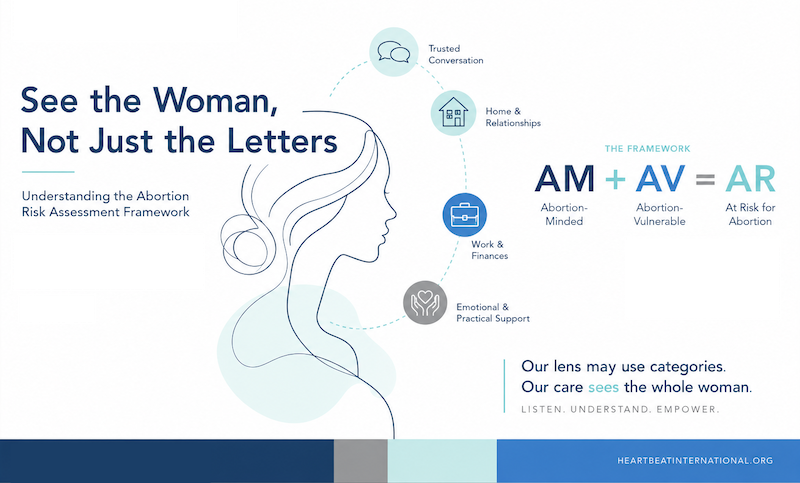
So What Do AM, AV and AR Mean?
AM = Abortion-Minded
An Abortion-Minded (AM) client appears to be planning or intending to obtain an abortion.
The framework identifies three possible indicators, and any one may qualify:
- She is seeking information about how to obtain an abortion.
- She has an abortion scheduled, even if she seems tentative.
- She has begun the abortion process.
When you hear these things, don’t just check a box. Listen for the story behind the question.
“Tell me more about what you’re thinking” may reveal far more than the initial question.
AV = Abortion-Vulnerable
An Abortion-Vulnerable (AV) client may not be actively planning an abortion but is facing circumstances that could make continuing her pregnancy feel overwhelming or beyond what she feels able or willing to handle.
The framework identifies five possible factors, and any one may indicate vulnerability:
- She has not ruled out abortion.
- She lacks support from significant people in her life or is experiencing pressure to consider abortion.
- She is undecided.
- She has a medical concern she believes may affect her pregnancy.
- She is single.
Vulnerability is an invitation to care.
Does This Mean Every Single Woman Is Considered Vulnerable?
This is one of the most common questions about the framework, and it’s an important one.
Under the framework, yes—being single is one of the identified indicators of Abortion-Vulnerability (AV).
That can understandably raise questions, especially because many of the women we serve are single.
But the framework is not saying that being single makes a woman inherently vulnerable, incapable of parenting, or likely to choose abortion. Rather, it identifies single status as a factor that should prompt us to look more closely at the circumstances surrounding her pregnancy.
A single woman may have a strong support system, stable housing, financial resources, and a deep commitment to carrying her pregnancy. Another may be facing significant pressure, isolation, financial concerns, or uncertainty.
Being single is an AV factor, but it doesn’t tell us the whole story of her circumstances.
Our responsibility is not to assume vulnerability, but to assess it. We listen, we ask questions, and we seek to understand her individual circumstances so that our response is based on the woman in front of us—not simply the category she meets.
The assessment tells us where to look. The woman tells us what we need to see.
Is AV About Inflating Our Numbers?
Another concern we sometimes hear is that using the AV category—especially when many of our clients are single—can feel like we are simply inflating our abortion-risk numbers.
That is not the purpose of the assessment.
If a client meets an AV criterion, we should assess and record it accurately. We should never add clients to a category to make our numbers look better—or leave one out because the result makes us uncomfortable.
Good data is a responsibility. We owe it to our constituents, our staff and volunteers, and our movement to accurately understand who we are serving and what they are facing.
Reliable data helps us evaluate our effectiveness, identify needs, steward resources, and strengthen the work of pregnancy help.
AR = At Risk for Abortion
Here’s where our equation comes in:
AM + AV = AR
The framework considers both Abortion-Minded and Abortion-Vulnerable clients At Risk for Abortion, recognizing a significant likelihood of choosing abortion without life-affirming intervention.
This is why the assessment matters. When a woman is identified as at risk, we have an opportunity to respond intentionally—to understand the barriers she is facing, offer practical support, connect her with resources, and involve qualified personnel when appropriate.
The goal is not simply to identify risk. The goal is to understand what is creating that risk and respond with meaningful care.
LC = Likely to Carry to Term
There is one more category: Likely to Carry to Term (LC).
Unlike AM and AV, where any one listed factor may apply, LC requires all three:
- She has stated that she has decided to carry to term.
- Indications reveal a healthy pregnancy.
- She has support from significant influences in her life.
Even here, the assessment is about understanding the client, not simply assigning a label. Every woman deserves compassionate care.
Why Consistency Matters
The framework is designed for trained pregnancy help staff and volunteers. Everyone involved in client care should understand the categories and know what to listen for, while remaining within the scope of their training and role.
Consistent use matters because important information can easily be missed. One staff member may hear a concern that another never hears. A shared framework helps the team recognize risk, communicate clearly, and respond appropriately.
The assessment should lead to action.
If a woman is worried about finances, explore resources. If she feels alone, help identify support. If she is experiencing pressure, give her a safe place to talk. If she has medical concerns, involve qualified clinical personnel.
The assessment is the beginning, not the end.
It helps us see where a woman may need us to lean in a little closer.
See the Woman, Not Just the Letters
AM, AV, AR, and LC are tools. They help us recognize risk and respond more intentionally, but they never tell the whole story of the woman sitting across from us.
Learn the letters. Know the framework. Use it consistently.
But always look beyond the letters to the woman in front of you.
We assess so we can understand. We understand so we can respond. And we respond because every woman and every child deserves the opportunity to flourish.
Abortion Risk Assessment Framework adopted by the Leadership Alliance of Pregnancy Care Organizations (LAPCO), 2017; updated 2025.